
If your vet has pointed at your older dog's spine X-ray and said "spondylosis," the word sounds worse than the finding usually is. Spondylosis (its full name is spondylosis deformans) is a very common, age-related build-up of small bony spurs along the spine, and in many dogs it is found by chance and causes no trouble at all. It is not cancer, it is not an infection and it is not something you caused. Here is what the spurs are, why they form, what the X-ray can and cannot tell your vet, and when a stiff back needs more than a shrug.
What "spondylosis" means on a dog's X-ray
The spine is a row of bones called vertebrae, with a soft cushion, the disc, between each pair. Spondylosis is new bone that grows out from the edges of the vertebrae, usually along the underside and sides of the spine, into the space where the disc sits. On an X-ray it shows as small beak-like points, and over time the spur from one bone can meet the spur from the next and form a bony bridge. It is ordinary bone in an extra place, not a tumor.
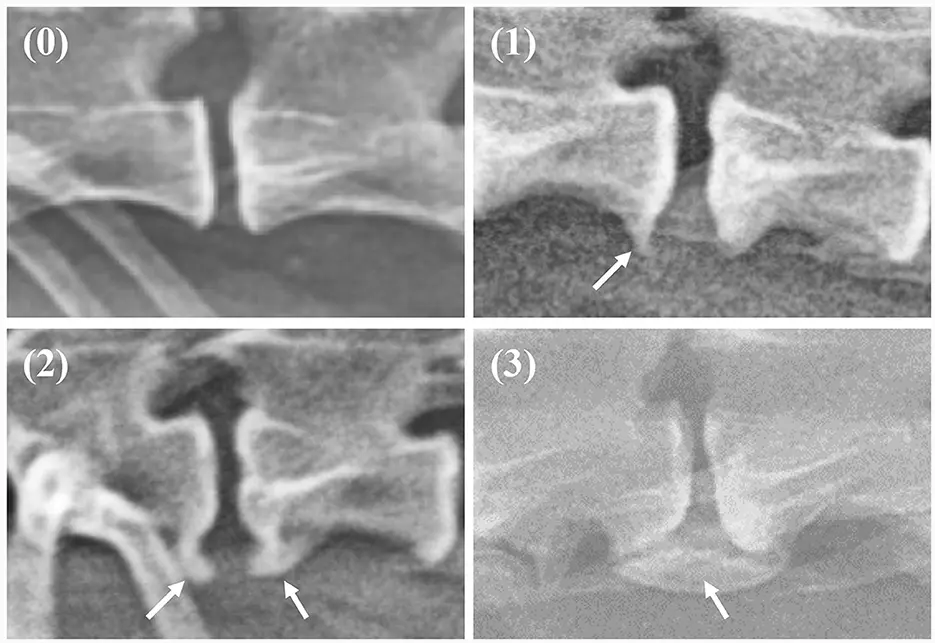
The picture at the top of this page shows how the finding is graded, in four close-ups of the gap between two spine bones from a published study. In (0) the edges are clean. In (1) a small spur, marked by the arrow, has started. In (2) the spurs are bigger but the two sides have not met, and in (3) the spur has grown across the gap to form a bridge. Vets use different grading schemes, so your report may say mild, moderate or bridging instead.
Why it forms, and which dogs get it
The exact cause is not fully understood, but the leading idea is simple wear. As a dog ages, the tough fibers that tie a disc to its neighboring bones weaken and the joint moves slightly more than it should, and the body responds by laying down extra bone at the edges to steady it. That is why spurs often sit beside disc wear, and why they are most often seen where the back works hardest: the lower chest, the lower back and the joint in front of the pelvis.
- Age: the chance of spurs rises with every year, so it is most common in senior dogs
- Breed: large breeds are over-represented and Boxers are especially well known for it, which suggests an inherited tendency
- Wear and tear: dogs with disc disease, a past spinal injury, years of hard athletic work or extra weight are thought to be more likely to have spurs
Is spondylosis serious, and does it hurt?
Usually it is not serious, and often it does not hurt. Many dogs with spurs, including some with large bridging ones, are never stiff a day in their lives, and the spurs turn up while the vet is looking at something else. When signs do appear they creep in slowly:
- Stiffness when getting up, especially after rest or on cold mornings, that eases after a few minutes of walking
- Less spring: hesitating before jumping into the car or onto the sofa, or slowing down on stairs
- A shorter stride, or a back that seems less supple, such as not curling round to scratch
- A hunched stance, or sensitivity when the back is stroked or pressed
None of these signs is specific to spondylosis, and a dog can have spurs and another problem at the same time. Hip dysplasia and other hip arthritis, lumbosacral disease at the base of the spine and a disc extrusion (IVDD) can look much the same from the owner's side, so your vet will examine the whole dog and not just the spine.
Spondylosis on its own is not an emergency, but a sore back can be something else. See a vet today if your dog suddenly cannot use or drags its back legs, strains to urinate or passes no urine, has new accidents with urine or stool, cries out in severe pain, or has a painful back together with a fever and loss of appetite.
What the spine X-ray shows, and what it cannot
An X-ray is the usual way to find spondylosis, because bone shows up clearly. Most clinics take a side-on view, often with a second view from above or below, and a dog in pain may need light sedation to lie straight and still. The vet or radiologist looks at:
- The spurs: where they are, how many, how big and whether any bridge the gap, which can make that stretch of spine stiffer
- The disc spaces: whether the gap between bones is even or narrowed, since a narrowed space suggests a worn disc
- The edges of the bones: in spondylosis the spurs look smooth and well formed, whereas ragged, eaten-away edges beside a collapsed disc space point to an infection of the disc (discospondylitis), a different problem with its own treatment
- The bone itself: dark moth-eaten patches or untidy new bone can suggest a tumor, which is far less common than spondylosis, and our guide to bone tumors on X-ray shows what that looks like
The limits matter as much as the findings. An X-ray shows bone, not the spinal cord, nerves or discs, so it can say that spurs are present but not that they are the reason your dog is sore, and it cannot rule out a disc pressing on the cord. Spurs also appear in dogs with no signs, so the picture is always read alongside the examination. If your dog is weak, wobbly or in pain that does not fit, the usual next step is MRI or CT, which show the cord, nerves and discs directly.
Treatment: looking after the dog, not the X-ray
The spurs themselves are not treated: no medicine dissolves them, there is no routine operation to remove them, and a dog with no signs needs no treatment at all. When the back is stiff or sore, the plan is about comfort and keeping your dog moving:
- A healthy weight, often the most helpful single step, because a lean dog puts less load on the spine
- Regular, steady, low-impact exercise: daily lead walks of a similar length, and swimming or hydrotherapy if available, rather than one long outing after a quiet week
- Pain relief prescribed by your vet, usually an anti-inflammatory made for dogs, with blood tests first in older dogs
- Physiotherapy to keep the muscles that support the spine strong; some clinics also offer acupuncture or laser therapy, though the evidence for those is more limited
Surgery is not a treatment for spondylosis itself. It is considered only in the uncommon dog where a spur presses on a nerve or the spinal cord, or when scans find something else, such as a disc extrusion, that needs it. Spondylosis does not go away and spurs usually grow slowly over years, but that does not mean a dog will get steadily worse, and repeat X-rays are normally needed only if the signs change.
Making life easier at home
- Put non-slip rugs on smooth floors, use ramps for the car and the sofa, and keep nails short for grip
- Give your dog a thick, warm bed away from drafts, and keep walks calm and regular, with no repeated jumping or rough play
- Never give human painkillers such as ibuprofen, acetaminophen (paracetamol) or aspirin, which can be toxic to dogs, and give only what your vet prescribes
Why a second read can help
Spondylosis is easy to find but harder to weigh. The useful question is not whether spurs are there but whether they explain your dog's signs, and whether anything else on the film, such as a narrowed disc space, a ragged bone edge or a patch of odd-looking bone, deserves a closer look. If the report leaves you unsure, or your dog's signs and the X-ray do not seem to match, you can ask a veterinary radiologist to re-read the X-rays you already have.
DocOrbit offers a veterinary radiology second opinion online: a veterinary radiologist re-reads your dog's own images, and you can ask what the findings mean for treatment. A radiologist cannot examine your dog or feel how its back legs respond, so this gives you and your vet another careful look at the same pictures and does not replace the vet who treats your dog.
Is spondylosis in dogs painful?
Often not. Many dogs with spurs, even large ones that bridge the gap between two bones, show no signs at all, and the spurs are found by chance. When a dog is stiff or sore the spurs can be part of the picture, but your vet will also look for other causes such as hip problems, disc disease or lumbosacral disease, because the spurs alone do not always explain the pain.
Does spondylosis in dogs get worse over time?
The spurs usually grow slowly, over months to years, and some eventually bridge the gap between two spine bones. More bone on the X-ray does not always mean more discomfort, and plenty of dogs stay comfortable for life. A healthy weight, steady exercise and a pain plan from your vet help keep a dog moving, and repeat X-rays are usually needed only if the signs change.
Can a dog with spondylosis still go for walks?
Yes, and regular gentle exercise is usually good for the spine. Short, steady lead walks suit most dogs better than rare long or rough outings, and swimming is a low-impact option many vets like. Avoid repeated jumping and hard twisting games, and ask your vet how much exercise is right if your dog is sore.
Key takeaways
- Spondylosis is a common, age-related growth of bony spurs along the spine, often found by chance, and it is not cancer or infection
- Many dogs with spurs, even bridging ones, have no pain, and the X-ray is read alongside the examination because the spurs may not explain the signs
- The spurs are not treated; a stiff dog is helped by a healthy weight, steady exercise, vet-prescribed pain relief and changes at home, and surgery is rarely needed
- Sudden weakness in the back legs, being unable to urinate, or a painful back with a fever are not signs of simple spondylosis and need a vet today
Can I ask a veterinary radiologist about my dog's X-ray report online?
Yes. Online veterinary radiology second opinions run entirely from home: you upload your dog's images, with no CD to post and no second trip to a specialty clinic, and a subspecialist veterinary radiologist re-reads the study and writes a structured report you can give to your own vet. DocOrbit returns that signed second read in 24 to 48 hours, and you can message the veterinary radiologist afterward with questions about the X-rays and about what they mean for your dog.
This article is for general information only and is not veterinary advice. Always discuss your animal's imaging results and next steps with a qualified veterinarian.