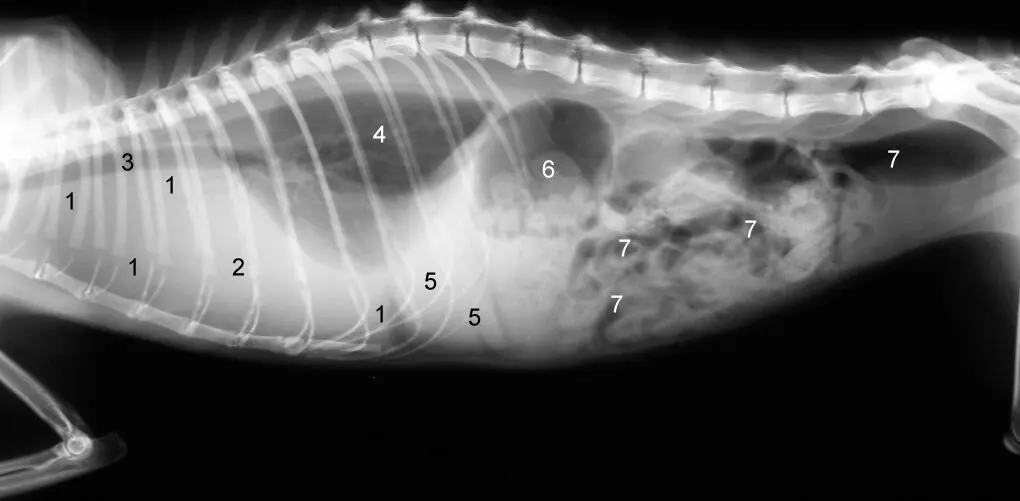
If your vet used the words "pleural effusion" after your cat's chest X-ray, or the report mentioned "fluid around the lungs," here is the reassuring part first: pleural effusion is a finding, not a disease in its own right. It means fluid has built up in the space around the lungs, and while some of the conditions behind it are genuinely serious, the fluid itself can usually be drained quickly to bring fast relief while your vet works out what caused it. This article covers what the finding actually means, what it looks like on an X-ray, why it happens, which signs mean same-day care, and how it is diagnosed and treated.
What is pleural effusion, and what does it look like on an X-ray?
The pleural space is a thin, normally almost-empty gap between the lungs and the inside of the chest wall. In a healthy cat it holds only a whisper of lubricating fluid, just enough for the lungs to slide smoothly as the chest expands. Pleural effusion means that gap has filled with a meaningful volume of fluid instead, and because fluid takes up room the lungs would otherwise use, it squeezes the lungs smaller and makes every breath more work.
On a normal chest X-ray, air-filled lung shows up dark, and the heart's outline stands out sharply against it. With pleural effusion, fluid pools around the lungs and shows up pale and solid-looking, exactly where dark, aerated lung should be. The lung lobes often retract away from the chest wall and float, sometimes with rounded edges, in the fluid around them. Just as tellingly, the heart's border, normally crisp against aerated lung, blurs or disappears entirely, because fluid and the heart show up at almost the same density on X-ray. Vets sometimes take a view from above or below the cat rather than the usual side-on view, since it is gentler for a cat already working hard to breathe.
What causes pleural effusion in cats?
Several quite different problems can end with fluid in the same place, which is why finding pleural effusion on an X-ray is the start of the workup, not the end of it. It is also a distinct picture from the patchy bronchial pattern radiologists look for in feline asthma, another common reason a cat's chest X-ray gets a close second look. The most common causes of pleural effusion in cats:
- Heart disease, most often hypertrophic cardiomyopathy, the most common heart condition in cats; when a cat's heart fails, fluid tends to back up into the chest rather than into the lungs themselves, which is the opposite of what usually happens in dogs
- Feline infectious peritonitis (FIP), the "wet" or effusive form, once one of the most feared feline diagnoses and now far more treatable with modern antiviral medication than it was only a few years ago
- Cancer, with lymphoma the most common culprit, sometimes as a mass in the middle of the chest in younger cats
- Pyothorax, a pus-filled infection of the pleural space, often traced back to a cat-fight bite wound or an inhaled grass awn that migrated into the chest
- Chylothorax, a leak of lymphatic fluid, sometimes linked to heart disease and sometimes with no cause ever pinned down
- Trauma, bleeding into the chest after a fall, a car accident, or another significant injury
Is pleural effusion in cats an emergency?
Cats are notoriously good at hiding how hard they are working to breathe, right up until they are in real trouble, so pleural effusion is treated with urgency rather than alarm until it is proven otherwise. Open-mouthed breathing is one of the clearest red flags of all, because cats almost never pant the way dogs do, so a cat breathing through an open mouth is telling you something is genuinely wrong. Other signs that need a vet immediately, not a wait-and-see approach: fast, shallow breathing at rest, sitting hunched with the elbows pushed out and the neck stretched forward, bluish or greyish gums, or sudden collapse.
This is also why, in a cat that arrives struggling to breathe, draining the fluid usually comes before an exhaustive workup. Relieving the pressure on the lungs buys time, and safety, to figure out the cause properly.
Symptoms
The signs owners notice tend to center on effort of breathing rather than anything more specific:
- Faster or more labored breathing, sometimes with visible movement of the belly with each breath
- Reduced activity, hiding, or general quietness
- A smaller appetite than usual
- Reluctance to lie fully on one side, since it can make breathing feel harder
Some of the most useful clues, like muffled heart or lung sounds, are only picked up by a vet listening with a stethoscope, which is one reason a cat that seems just "a bit off" is still worth a same-day exam rather than a wait-it-out approach.
How is pleural effusion diagnosed and followed up?
A chest X-ray is usually the first imaging test, though a quick point-of-care ultrasound at an emergency clinic can confirm fluid without needing to position a struggling cat for X-ray views. Once fluid is confirmed, the next step is usually thoracocentesis: draining a sample with a needle, which relieves breathing and also gives a sample to analyze. The fluid's color, clarity, and cell content sort it into broad categories, such as a thin transudate, a thicker exudate, a milky chylous fluid, or blood, and each of those categories points the workup toward a shorter list of likely causes.
Depending on what the fluid analysis suggests, follow-up testing might include an echocardiogram to look closely at the heart, blood tests or fluid testing for FIP, or cytology to look for cancer cells or bacteria under the microscope. Once treatment starts, repeat imaging confirms the fluid is not building back up.
How is pleural effusion treated?
Treatment always has two parts: relieving the fluid itself, and treating whatever is causing it.
- Thoracocentesis for immediate relief, repeated as needed while the underlying cause is treated
- Oxygen support for cats that are struggling to breathe
- Diuretics and heart medication when heart disease is the cause
- Antiviral therapy for FIP, which has substantially improved the outlook for this diagnosis
- Antibiotics and drainage, sometimes with a temporary chest tube for repeated flushing, for pyothorax, which often means several days in the hospital
- Chemotherapy for lymphoma and other cancers
- A low-fat diet or, in some cases, surgery, for chylothorax
Living with a cat that has had pleural effusion
Once a cat is stable, one of the simplest and most useful habits an owner can build is counting resting breathing rate while the cat is asleep or resting quietly. A healthy resting rate is well under 30 breaths a minute, and a rising trend over days is often the earliest sign that fluid is building back up, well before a cat looks obviously unwell. Keeping follow-up recheck appointments and staying consistent with any medication schedule matters just as much, especially for a chronic cause like heart disease.
Why a second read can help
Pleural fluid can silhouette so much of the chest that a mass, an early heart change, or another detail hiding behind it only becomes clear once the fluid is drained and a repeat film is taken. Having an online veterinary radiologist look at the same films, especially the pair taken before and after drainage, can catch details that a first pass, done under real time pressure, does not always fully resolve. DocOrbit's veterinary radiology second opinion service takes the images you already have and returns a subspecialist's written report you can share with your own vet, and you can also ask a veterinary radiologist follow-up questions about what the findings mean for your cat. It is an additional expert opinion on the same images, not a replacement for your treating vet, and it can matter most in exactly the borderline cases described here.
Is pleural effusion in cats always an emergency?
Not always, but breathing difficulty in a cat is treated as urgent until proven otherwise, because cats hide distress well and can decline quickly. A cat found to have a small amount of fluid by chance, still eating and moving normally, is a very different situation from one working hard to breathe with its mouth open. If there is any doubt, treat rapid, labored, or open-mouthed breathing as same-day, and ideally immediate, care.
What is the most common cause of pleural effusion in cats?
Heart disease, most often hypertrophic cardiomyopathy, and feline infectious peritonitis are the two most frequently diagnosed causes. Cancer, particularly lymphoma, and an infection of the pleural space called pyothorax are also common enough that vets routinely test for them. Which one is behind a particular cat's effusion usually becomes clear once the fluid itself is analyzed.
Can a cat fully recover from pleural effusion?
It depends far more on the underlying cause than on the fluid itself. A cat with pyothorax that is drained and treated with antibiotics, or FIP caught early and treated with modern antiviral medication, can make a full recovery. Effusion from advanced heart disease or cancer is usually managed rather than cured, though many cats still do well for a good stretch of time with treatment.
How is fluid drained from a cat's chest?
A vet performs a procedure called thoracocentesis, passing a thin needle or catheter through the chest wall to draw the fluid out with a syringe, usually with light sedation or gentle restraint. Most cats breathe noticeably easier within minutes, and the fluid collected is sent to a lab to help identify the cause. It is often repeated if fluid builds back up while the underlying condition is being treated.
Key takeaways
- Pleural effusion means fluid around the lungs, not a diagnosis in itself; the underlying cause is what determines the outlook
- Heart disease, especially hypertrophic cardiomyopathy, and FIP are the two most common causes in cats, alongside cancer, infection, and trauma
- Rapid or open-mouthed breathing, bluish gums, or sudden collapse are emergencies that need a vet immediately, similar to the urgency owners learn to recognize with a blocked cat
- Draining the fluid usually brings fast relief and also supplies the sample needed to find the cause
- Treatment and outlook vary widely by cause, from a full recovery after pyothorax to lifelong management of heart disease
Can I ask a veterinary radiologist about my cat's X-ray online?
Yes. Online veterinary radiology second opinions run entirely from home: you upload your images, with no CD to post and no second trip, and a subspecialist veterinary radiologist re-reads the study and writes a structured report you can give to your own vet. DocOrbit returns that signed second read in 24 to 48 hours. You can then message the veterinary radiologist with questions about the X-ray and about what the fluid means for your cat.
This article is for general information only and is not veterinary advice. Always discuss your animal's imaging results and next steps with a qualified veterinarian.