If your dog suddenly skips for a few steps on a back leg, holds the foot up and then trots on as if nothing happened, or your vet has said "patellar luxation," "luxating patella" or "slipping kneecap," it is natural to worry. The reassuring part first: this is one of the most common knee problems in small dogs, it is rarely an emergency, many mild cases never need an operation, and when surgery is needed the results are usually good. Here is what the skipping step means, how vets grade it and what the X-ray shows.
What "patellar luxation" means
The kneecap (patella) is a small bone embedded in the tendon of the big thigh muscles at the front of the knee. Each time the knee bends and straightens, it should glide up and down in a groove at the end of the thigh bone (the femur). "Luxation" means dislocation: the kneecap slips out of the groove and then usually slides back in.
In most dogs, especially small ones, it slips to the inside of the knee (medial luxation). Slipping to the outside (lateral luxation) is less common and is reported more often in large and giant breeds. The cause is usually developmental rather than an injury: the groove is too shallow, or the thigh bone and shin bone (the tibia) are slightly bowed or twisted, so the thigh muscle pulls off to one side and drags the kneecap out of its track. Many dogs are affected in both knees.
Which dogs are affected
Toy and small breeds are affected most: Chihuahuas, Yorkshire Terriers, Pomeranians, Poodles, Maltese, Bichon Frisés, Boston Terriers and Pekingese are reported often, and larger dogs can be affected too. The tendency is inherited, so responsible breeders have their breeding dogs' knees examined (the Orthopedic Foundation for Animals in the United States offers a hands-on patella evaluation). None of this means you did anything wrong. Affected dogs are also more prone to a cruciate ligament tear, so your vet will look at the whole leg rather than one joint.
The skipping step and other signs owners notice
The classic sign is a sudden skip. Your dog is running, then lifts one back leg, hops a few strides on three legs, sometimes kicking the leg out behind, and carries on normally. That is the kneecap popping out and slipping back in as the muscle relaxes. Signs usually start in young dogs, though a mild luxation can go unnoticed for years.
- A skip or hop on one back leg that comes and goes, often while running, sometimes with a yelp
- Stiffness or lameness in a back leg after exercise or after rest
- Reluctance to jump onto the sofa or climb stairs
- In advanced cases, a bow-legged stance and a crouched walk, with the leg held partly up or not used
A skipping step is not an emergency, but a back-leg limp always needs checking, because other problems look similar: a torn cruciate ligament, hip dysplasia, Legg-Calvé-Perthes disease in young small dogs and, as our guide to IVDD on spinal MRI explains, a spinal problem that makes a back leg scuff or give way. Book a vet visit within a day or two if the skipping is becoming more frequent, and see your vet today if your dog suddenly will not put the leg down, cries out when the knee is touched, has a hot, swollen knee or has had a fall or an accident.
How patellar luxation is graded
Vets grade the kneecap from 1 to 4 by feeling the knee and moving the kneecap with their hands. In plain language:
- Grade 1: the kneecap can be pushed out by hand but slides straight back, and it does not usually pop out on its own. Many dogs show no signs.
- Grade 2: the kneecap pops out by itself from time to time, often when the knee bends, and stays out until the leg straightens or the vet pushes it back. This is the classic skipping step.
- Grade 3: the kneecap is out of its groove most of the time. It can be pushed back but slips out again, and dogs often walk crouched.
- Grade 4: the kneecap is permanently out and cannot be pushed back. The leg is often twisted, and the dog may barely use it.
The grade says how far the kneecap has moved, not how sore your dog is: some dogs have a high grade and few signs, others a lower grade and obvious discomfort.
What patellar luxation looks like on an X-ray
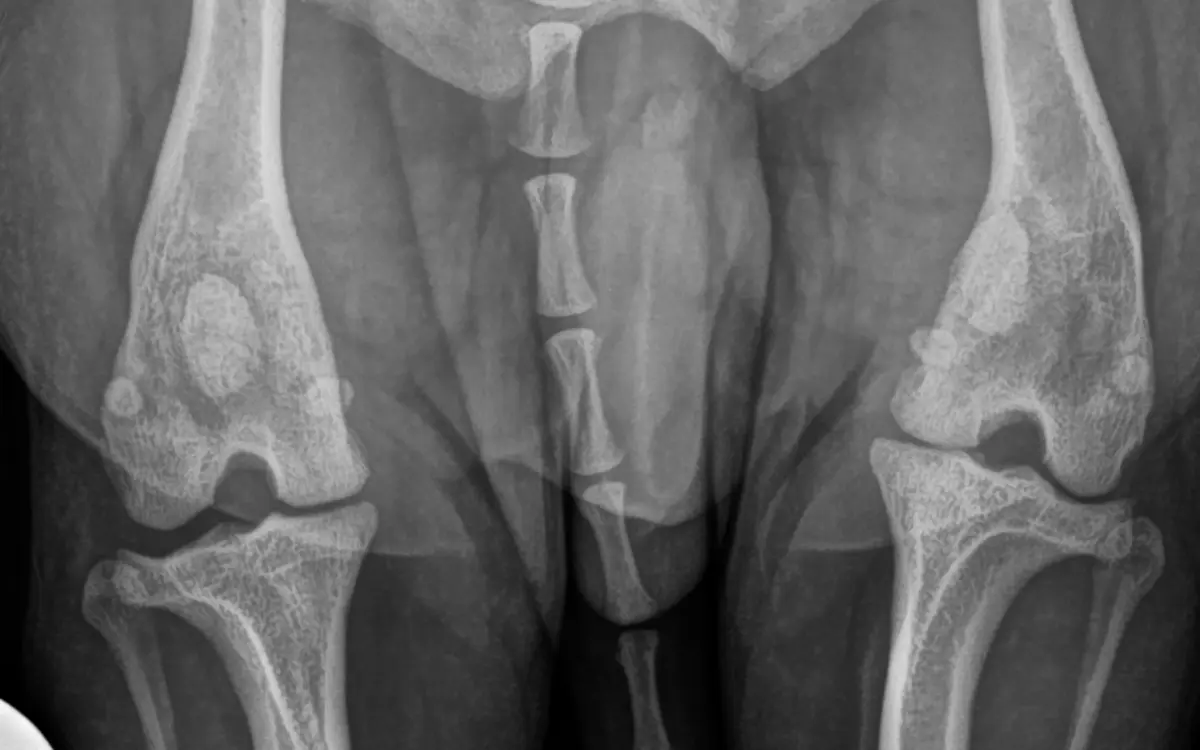
The diagnosis is made mostly with hands rather than pictures: a vet can feel whether, and in which direction, the kneecap slides out, and no X-ray replaces that. X-rays still matter, because they show the bones behind the problem and the damage it has done. Vets usually take a front-to-back view of both hind legs and a side view of the knee, sometimes under sedation.
The picture at the top of this page is a front-to-back (ventrodorsal) view of both knees of a dog, and its uploader reports that both kneecaps have slipped to the inside. Even here the kneecap is a small oval bone lying over the thigh bone, which shows why the hands-on exam carries so much weight. Radiologists look for:
- A kneecap sitting to the inside or outside of its groove instead of in line with it
- A shallow or flattened groove at the end of the thigh bone
- Bowing of the thigh bone and a twist in the shin bone, which pull the kneecap off its track and matter when a surgeon plans an operation
- Wear: bone spurs (osteophytes) around the kneecap and groove, and fluid in the joint, which can also point to a cruciate ligament problem
The honest catch is that the kneecap moves. If it sits in its groove when the picture is taken, which is common with grades 1 and 2, the X-ray looks normal, so a normal-looking X-ray does not rule out a luxating patella in a dog that is skipping. Before complicated surgery, a CT scan can measure the bowing and twist more precisely.
Managing patellar luxation without surgery
Grade 1 and many grade 2 knees, especially in dogs that are comfortable and only skip now and then, are managed without an operation and rechecked to see whether things are changing.
- Weight control: extra weight strains the knees, and keeping your dog lean is the most useful thing you can do at home
- Controlled exercise: steady lead walks instead of ball chasing, sharp turns and repeated jumping, a ramp instead of leaping off the sofa, and non-slip rugs on slippery floors
- Physiotherapy and hydrotherapy to build the thigh muscles that keep the kneecap in line
- Pain relief prescribed by your vet when the knee is sore. Never give human painkillers such as ibuprofen or paracetamol, which can be toxic to dogs.
Do not push the kneecap back yourself unless your vet has shown you how, because forcing a sore knee can make things worse.
When surgery is considered
Surgery is usually advised for grades 3 and 4, for a grade 2 knee that keeps slipping or causing lameness, and for young dogs whose bones are deforming. Surgeons tailor the operation to what is wrong and often combine steps:
- Deepening the groove (trochleoplasty) so the kneecap sits securely
- Moving the bump on the shin bone where the kneecap's ligament attaches (tibial tuberosity transposition) so the pull runs straight
- Tightening the tissue on the side the kneecap slips toward and releasing the tissue pulling from the other side, and for severe bowing or twisting, cutting and realigning the bone
Most dogs do well and return to comfortable, normal use after several weeks of restricted activity and rehabilitation. The kneecap slips out again in a minority, more often when the bones were very deformed, and surgery cannot reverse arthritis that has already started. Whether and when to operate is a decision to make with your vet or a surgeon.
Why a second read can help
Knee X-rays are harder to read than they look: the kneecap is small and overlaps the thigh bone, the picture is a single frame of a bone that moves, and calls such as how shallow the groove is, how much the bones are twisted and whether swelling in the joint hints at a cruciate problem are judgment calls. Each can change the plan, which may involve a CT scan or an operation. Before you commit, you can ask a veterinary radiologist to re-read the X-rays you already have.
DocOrbit offers a veterinary radiology second opinion online: your dog's own X-rays are re-read by a veterinary radiologist, and you can ask what the findings mean for treatment. A radiologist cannot grade the knee by feel, so this gives you and your vet another careful look at the same images and does not replace the vet who examines and treats your dog.
Is a luxating patella painful for my dog?
It depends on the grade. In grade 1 and in many grade 2 knees the skip is brief, and dogs often seem comfortable straight afterward. Over time the repeated slipping can wear the cartilage and lead to arthritis, and higher grades are often sore. If your dog is limping, yelping or reluctant to jump, ask your vet about pain relief.
Does a luxating patella always need surgery?
No. Grade 1 and many grade 2 knees are managed with weight control, controlled exercise, physiotherapy and pain relief when needed, and are rechecked over time. Surgery is more often advised for grades 3 and 4, for a knee that keeps slipping or causing lameness, and for young dogs whose bones are deforming.
Can a normal X-ray rule out a luxating patella?
No. The kneecap moves, so it can be sitting in its groove at the moment of the X-ray, which is common with the milder grades. Your vet makes the diagnosis by feeling the knee and uses X-rays to look at the bones and at the wear on the joint.
Key takeaways
- Patellar luxation is a kneecap that slips out of its groove, most often to the inside in small dogs, with a sudden skip on a back leg as the classic sign
- Vets grade it 1 to 4 by feeling the knee; mild grades are often managed without surgery, grades 3 and 4 more often need it
- A normal-looking X-ray does not rule it out, because the kneecap moves
- A sudden refusal to use the leg, a hot, swollen knee or an injury needs a vet the same day
Can I ask a veterinary radiologist about my dog's knee X-rays online?
Yes. Online veterinary radiology second opinions run entirely from home: you upload your dog's images, with no CD to post and no second trip to a specialty clinic, and a subspecialist veterinary radiologist re-reads the study and writes a structured report you can give to your own vet. DocOrbit returns that signed second read in 24 to 48 hours, and you can message the veterinary radiologist afterward with questions about the X-rays and about what they mean for your dog.
This article is for general information only and is not veterinary advice. Always discuss your animal's imaging results and next steps with a qualified veterinarian.