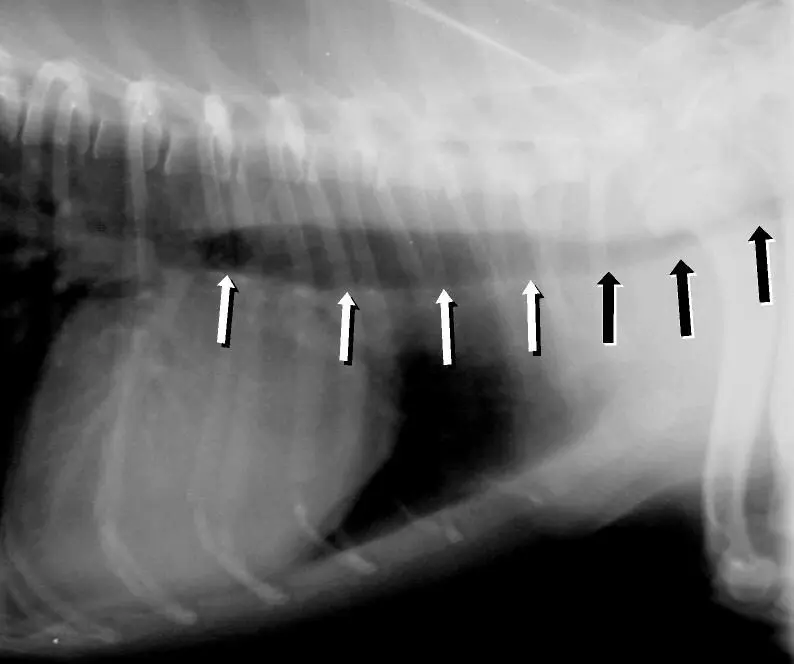
If your vet mentioned a "collapsing trachea" after hearing your dog's cough, or an X-ray report used the words "tracheal collapse," the sound is probably what brought you here in the first place: a dry, honking cough that sounds uncannily like a goose, often set off by excitement, a warm room, or a tug on the leash. Here is the reassuring truth up front. Tracheal collapse is one of the most common chronic airway conditions in small-breed dogs, most cases are mild to moderate, and the large majority of affected dogs live full, comfortable lives once the diagnosis is made and a management plan is in place. This article covers what the finding actually means, what it looks like on an X-ray, which dogs get it, the warning signs worth knowing, and how it is treated day to day.
What is a collapsing trachea?
The trachea, or windpipe, is normally held open by a stack of C-shaped cartilage rings that keep the airway rigid no matter how hard your dog is breathing. In a dog with tracheal collapse, those rings have lost some of their normal stiffness, most often because the cartilage itself contains less of the structural material that keeps it firm. The rings flatten instead of holding their shape, and the soft band of tissue that closes the open part of the C, the dorsal membrane, can bow inward and narrow the airway even further.
The result is a windpipe that behaves like a drinking straw with a soft spot: pull air through it quickly, or put pressure on it, and it flattens. That flattening is what produces the sound most owners describe as a goose honk, a dry, repetitive cough that often ends in a gag or retch, without ever bringing anything up.
What does it look like on an X-ray?
A plain X-ray of the neck and chest is usually the first imaging test, and a radiologist reads it by following the air-filled column of the trachea along its length, looking for a segment that is narrower than the rest of the tube.
Where the narrowing shows up matters. The trachea in the neck tends to collapse on the in-breath, when the chest wall is pulling air in and pressure inside the airway briefly drops. The trachea inside the chest, and the point where it branches into the two main airways, tends to collapse on the out-breath instead. A radiologist reading the film has to weigh both phases, because a dog can have a completely normal-looking trachea on one and an obviously narrowed one on the other.
This is also the finding's biggest limitation: tracheal collapse is often dynamic and intermittent rather than constant, so a single still X-ray taken at the wrong instant can look reassuringly normal even in a dog with a textbook honking cough. Vets sometimes take the film while the dog is coughing, or gently press on the trachea, to improve the odds of catching the narrowing in the act. When suspicion stays high despite a normal-looking X-ray, fluoroscopy, a moving, real-time X-ray, or bronchoscopy, a small camera passed into the airway under sedation, settles the question and also grades how severe the narrowing is, on a scale that runs from mild flattening to a trachea that closes almost completely.
Which dogs get a collapsing trachea?
This is overwhelmingly a small and toy-breed condition, and cartilage that is simply built weaker from birth is the starting point:
- Yorkshire Terrier, classically associated with the condition
- Pomeranian
- Chihuahua
- Toy and Miniature Poodle
- Maltese
- Shih Tzu
- Pug
A few things make the cough worse once the underlying weakness is there, and several of them are within an owner's control:
- Excess body weight, which adds pressure around the chest and airway
- Chronic irritation of the airway from smoke, dust, or long-standing bronchitis
- Pulling against a collar, which presses directly on the weakened cartilage in the neck
- Heart enlargement, which can physically press on the trachea from inside the chest and is worth ruling out alongside degenerative mitral valve disease in exactly this population of small breeds
Symptoms
The honking cough is the signature sign, and it has a fairly recognizable pattern: dry, repetitive, often ending in a gag, and reliably set off by excitement, warm or humid weather, drinking water quickly, or any pressure on the neck. Between episodes, plenty of affected dogs act completely normal.
- Reduced exercise tolerance or reluctance on walks
- A raspy, honking cough rather than a wet or productive one
- Retching or gagging without bringing anything up
- In more advanced cases, noisy breathing even at rest
Is it serious, and when is it an emergency?
For most dogs, tracheal collapse is a chronic condition to manage over years, not an emergency to fear every day, in the same way a joint condition like hip dysplasia is controlled long-term rather than cured overnight. Mild and moderate collapse, which covers the majority of diagnosed dogs, responds well to weight control and medication, and many go on to have a normal lifespan.
A tracheal collapse crisis is different, and it is a genuine emergency. If your dog's breathing becomes loud and labored at rest, a coughing spasm will not stop, the gums or tongue look blue or grey, or your dog seems panicked and unable to catch its breath, it needs a vet immediately rather than a wait-and-see approach. Heat and excitement are common triggers for a crisis, so a hot day combined with an exciting event is exactly when an owner of a known collapsing-trachea dog should be most watchful.
How is it treated?
Treatment usually starts conservatively and escalates only if it has to.
- Weight loss to an ideal body condition, which alone can noticeably reduce how often a dog coughs
- A harness instead of a collar, removing pressure from the front of the neck entirely
- Cough suppressants, to break the cycle where coughing irritates the airway and triggers more coughing
- Bronchodilators, which relax the airway muscle and can ease an acute flare
- A short course of anti-inflammatory medication during bad episodes, to calm airway swelling
- A mild sedative in some dogs, since anxiety and excitement are such reliable triggers
For the minority of dogs whose collapse is severe and does not respond adequately to medication, a tracheal stent, a small mesh tube placed inside the airway to hold it open, or a surgical prosthesis fitted around the outside of the trachea, can make a real difference. Both options are reserved for advanced cases and are planned around the grading obtained from fluoroscopy or bronchoscopy.
Lifestyle changes that help
- Use a harness for every walk, not just on bad days
- Keep walks shorter and calmer in hot or humid weather
- Work toward and maintain a lean body weight, with your vet's target as the guide
- Keep smoke, strong cleaning sprays, and other airway irritants away from your dog's environment
- Notice and, where possible, soften the specific triggers that set your own dog off, whether that is the doorbell, car rides, or a particular walking route
Why a second read can help
A collapsing trachea's dynamic, come-and-go nature is exactly what makes the X-ray one of the trickier films to read with full confidence: the degree of narrowing captured depends on the breathing phase, the timing of the exposure, and even how relaxed the dog was at that moment. If your dog's report leaves you uncertain, or a decision between medication and a stent hinges on the imaging, a second expert read of the same films can bring real clarity. DocOrbit offers an online veterinary radiologist second opinion that you can share with your own vet, built entirely from images you already have, which is especially useful when a mild-versus-moderate grading call changes the treatment plan. It also gives you the chance to ask a veterinary radiologist follow-up questions about the grading itself. It is an additional specialist opinion on the same pictures, not a replacement for your treating vet.
Is a collapsing trachea in dogs painful or serious?
Tracheal collapse is not usually described as a painful condition, but it is genuinely uncomfortable, and in its more advanced grades it can seriously limit a dog's ability to breathe normally. Most dogs are diagnosed with mild to moderate collapse and do well for years with weight control and medication. In severe or poorly controlled cases, a coughing fit can tip into a breathing crisis, which is why owners of affected dogs are taught to recognize the emergency signs early.
Which dog breeds are prone to a collapsing trachea?
Toy and small-breed dogs carry most of the risk, especially Yorkshire Terriers, who are so classically affected that some vets nickname the condition the Yorkie cough. Pomeranians, Chihuahuas, toy and miniature poodles, Maltese, Shih Tzus, and pugs are also commonly affected. Signs usually appear in middle age, though some dogs start coughing as young adults, and the cartilage weakness tends to worsen gradually over the following years.
Can a collapsing trachea in dogs be cured?
There is no cure that restores normal cartilage rigidity, so tracheal collapse is managed rather than fixed for the large majority of dogs. Weight loss, a harness instead of a collar, and medication to calm coughing and airway inflammation keep most dogs comfortable for the rest of their lives. A tracheal stent is reserved for the minority of dogs with severe, medication-resistant collapse, and even then it manages the condition rather than reversing it.
Why does my dog only cough when excited, in the heat, or pulling on a leash?
All three raise the speed of airflow moving through an already floppy trachea, which is exactly what triggers the tube to flatten further and set off a coughing spasm. Excitement and heat both increase breathing rate, and any pressure on the front of the neck, including a regular collar, pushes directly on the weakened cartilage. This is also why switching to a harness is one of the single most effective changes an owner can make.
Can a normal X-ray rule out a collapsing trachea?
Not reliably, because the collapse is often dynamic and comes and goes with the phase of breathing, so a still image taken at the wrong moment can look completely normal even in a dog with a textbook honking cough. Vets sometimes take the X-ray while the dog is coughing, or gently press on the trachea, to try to catch the collapse in the act. If suspicion stays high despite a normal-looking film, fluoroscopy or bronchoscopy gives a moving, more reliable answer.
Key takeaways
- Tracheal collapse is a common, usually manageable chronic airway condition in small and toy-breed dogs, most recognizable by its dry, honking cough
- On X-ray, the degree of narrowing depends on the breathing phase, so a normal-looking film does not rule it out
- Yorkshire Terriers, Pomeranians, Chihuahuas, and other toy breeds carry most of the risk, and weight or collar pressure make symptoms worse
- Most dogs are managed successfully with weight loss, a harness, and medication; a stent is reserved for severe, treatment-resistant cases
- Loud, labored breathing at rest or blue-tinged gums is an emergency that needs a vet immediately
Can I ask a veterinary radiologist about my dog's X-ray online?
Yes. Online veterinary radiology second opinions run entirely from home: you upload your images, with no CD to post and no second trip, and a subspecialist veterinary radiologist re-reads the study and writes a structured report you can give to your own vet. DocOrbit returns that signed second read in 24 to 48 hours. You can then message the veterinary radiologist with questions about the X-ray and about what the report actually means for your dog.
This article is for general information only and is not veterinary advice. Always discuss your animal's imaging results and next steps with a qualified veterinarian.