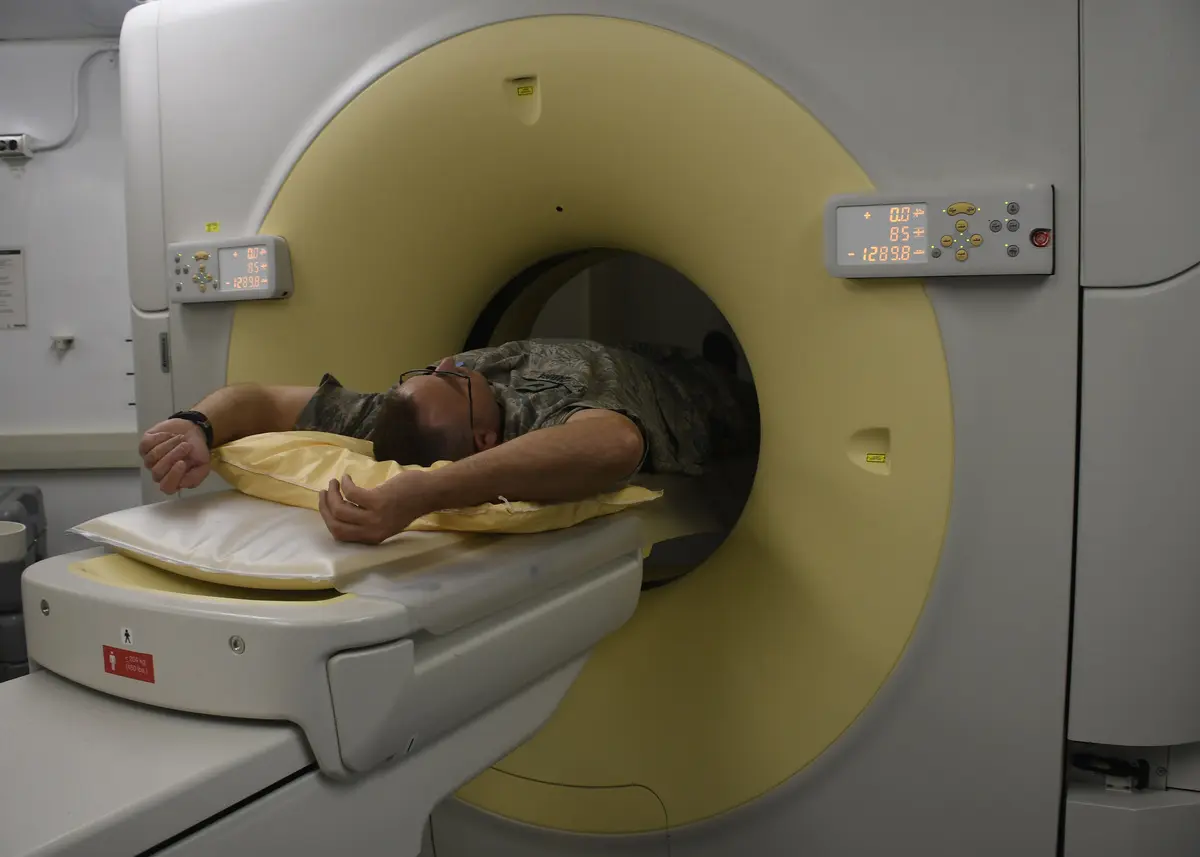
Neither. MRI and CT aren't ranked best to worst, they're built for different jobs, and the "better" scan is whichever one answers the question your doctor is asking. MRI (magnetic resonance imaging) uses a magnet and radio waves for the sharper picture of soft tissue: brain, spinal cord, ligaments, organs. CT (computed tomography, a fast, rotating X-ray) is faster, better at bone and acute bleeding, and often the only realistic option in an emergency. Stop reading right here and you already have the real answer: no universal winner, just the right tool for the problem in front of you.
How MRI and CT actually differ
An MRI machine surrounds you with a magnet tens of thousands of times stronger than the Earth's own field, then uses harmless radio waves, the same category of energy as FM radio, to read a signal from the water and fat in your tissue. No radiation, and a scan usually takes 30 to 60 minutes in a narrow tube.
A CT scanner is a fast-rotating ring of X-ray tubes that stacks hundreds of X-ray slices into one 3D image, essentially a plain X-ray computed into a volume. A single-region CT takes under a minute, through an open ring, using a low, controlled dose of radiation (the kind that can damage DNA at high doses). Our guide to radiation dose in radiology scans compares doses test by test.
What each scan is genuinely better at
Doctors don't pick between MRI and CT by habit, they pick by what needs to be seen. MRI is usually better for:
- Brain, spinal cord, and nerve tissue
- Ligaments, tendons, and cartilage (knees, shoulders, the spine)
- Detecting and characterizing many tumors, especially in the brain, breast, and liver, see can an MRI detect cancer
- Cases where avoiding radiation matters, such as pregnancy or repeated scans in children
CT is usually better for:
- Bone detail and fractures
- Acute bleeding, trauma, and stroke in the first minutes after symptoms start
- Chest and abdominal emergencies: appendicitis, bowel obstruction, aortic dissection
- Anyone who can't lie still for 30 to 60 minutes, is claustrophobic, or has a pacemaker or other MRI-incompatible implant
There's real overlap too, for many findings either would technically work, one is just faster or clearer.
Radiation, safety, and comfort
The clearest way to picture the tradeoff: a CT of the abdomen delivers a dose roughly equal to a few years of the natural background radiation everyone absorbs from soil, air, and sunlight anyway. An MRI's dose is zero, not low, zero (more on why MRI doesn't use radiation elsewhere). That doesn't make CT dangerous, doses are kept deliberately low, but it's why doctors default to MRI when radiation is worth avoiding, and to CT when speed or bone detail matters more.
The rest is about you, not the image. MRI means lying still in a narrow tube for half an hour or more with loud, repetitive knocking sounds, some people need a mild sedative for claustrophobia. CT takes seconds to a minute in an open ring, part of why it's the emergency-room default. Both can involve a contrast injection, MRI's gadolinium and CT's iodine-based agent carry different, generally low, risks your care team screens for beforehand.
How your doctor decides which one to order
You don't make this choice alone. Your doctor, or the radiologist they consult, matches the scan to the question: which body part, what's suspected, how urgent the answer is, and whether a contraindication like a pacemaker rules an option out. Sometimes both get done, one to catch something fast, the other to characterize it once the emergency has passed.
If you already have images back and the report leaves more questions than answers, an independent radiologist can review the same MRI or CT without another scan. That's the second read DocOrbit provides, typically within a day or two, with a report you can bring back to your own doctor.
Is MRI or CT better for a brain scan?
For most brain conditions, especially tumors and stroke follow-up, MRI shows brain tissue more sharply. The exception is the first minutes after a suspected stroke or head injury, when CT is faster and better at ruling out bleeding, so it's usually done first in the emergency room.
Which is faster, MRI or CT?
CT, by a wide margin. A CT scan typically takes seconds to about a minute, while an MRI usually takes 30 to 60 minutes because it builds the image from many separate signal readings. That's a major reason CT is the default in emergencies.
Can a CT scan show what an MRI shows?
Not always. CT is excellent at bone, acute bleeding, and speed, but has less contrast resolution for soft tissue, so subtle findings in the brain, spinal cord, or ligaments can appear on MRI and be missed on CT. The reverse is true too, some fractures and acute bleeding are clearer on CT.
Key takeaways
- Neither is universally "better", MRI and CT are built for different jobs
- MRI: sharper soft-tissue detail, no radiation, slower, a tighter tunnel
- CT: faster, better at bone and acute bleeding, uses a low dose of radiation
- Your doctor picks based on the clinical question, not a fixed ranking
How do I have my MRI reviewed by another radiologist online?
Yes. Online radiology second opinions run entirely from home: you upload your images, with no CD to post and no second trip, and a subspecialist radiologist re-reads the study and writes a structured report you can give to your own doctor. DocOrbit returns that signed second read in 24 to 48 hours. You can then message the radiologist with questions about the MRI and about what the report actually means for you.
This article is for general information only and is not medical advice. Always discuss your imaging results and any next steps with a qualified physician.