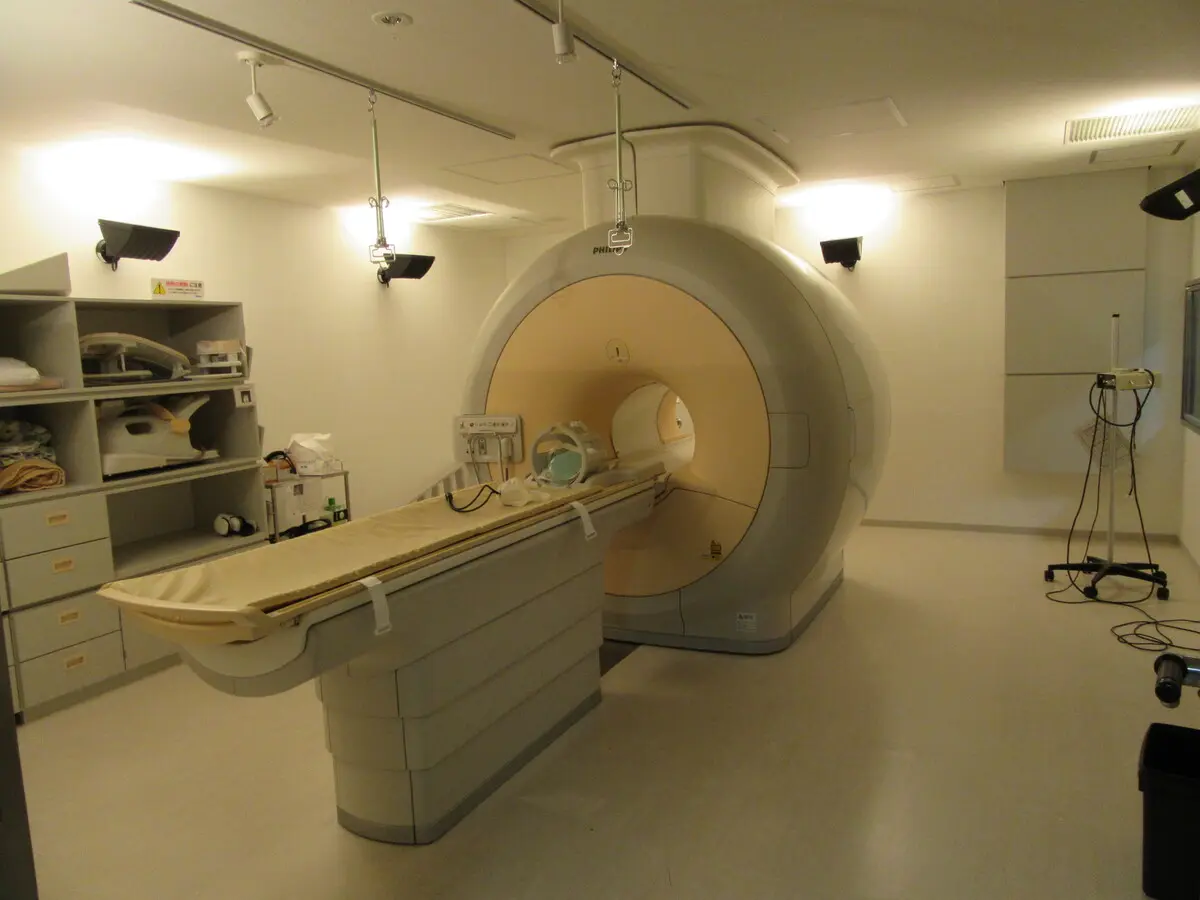
No. An MRI (magnetic resonance imaging) does not use radiation of any kind, not the ionizing kind that comes from X-rays and CT scans, and not any other kind either. It builds images using a strong magnet and radio waves, the same category of energy used by FM radio and Wi-Fi, just far more powerful and precisely aimed. The thing that actually matters for your safety in an MRI room isn't radiation at all, it's metal. Here's how the machine really works, which scans do use radiation, and what the metal question is really about.
How an MRI actually works
An MRI machine is built around a large, extremely strong magnet, roughly 10,000 to 60,000 times stronger than the Earth's own magnetic field. That magnet briefly lines up the hydrogen atoms already present in your body's water and fat, then a burst of radio waves (a harmless form of energy, weaker than a cell signal, that briefly knocks those atoms out of alignment) is sent through the tissue.
As the atoms snap back into place, they give off a faint radio signal of their own. A computer reads millions of those signals and turns them into the cross-sectional images your radiologist reviews. No ionizing radiation (the higher-energy kind that can damage DNA at high enough doses, the kind X-rays and CT use) is ever produced or absorbed by your body.
Which scans actually use radiation
Several common imaging tests do use ionizing radiation, in carefully controlled, low doses:
- X-rays, for bones, chest, and dental images
- CT scans (computed tomography, which stacks hundreds of X-ray images from different angles into one 3D picture)
- PET-CT and nuclear medicine scans, which use a small amount of a radioactive tracer injected into the blood
- Mammograms, a specialized low-dose X-ray of breast tissue
Ultrasound, like MRI, uses no radiation either, it relies on sound waves. If you're curious how the radiation doses of these tests compare to each other and to everyday background exposure, our guide to radiation dose in radiology scans breaks it down test by test.
Why the magnet matters more than the radiation
The real safety briefing before an MRI has nothing to do with radiation exposure. It's about the magnet. An MRI's magnet is strong enough to pull a loose steel object, an oxygen cylinder, a wheelchair, even a pair of scissors left in a pocket, clear across the room hard enough to injure anyone in its path.
That's why the technologist asks you to remove jewelry and metal clothing, empty your pockets, and disclose any implants, pacemakers, cochlear implants, or metal fragments before you go in. It's a real precaution, but a manageable one: most modern implants are labeled MRI-safe or MRI-conditional, and your care team checks compatibility before scheduling.
What about the contrast dye?
Some MRIs use a contrast agent called gadolinium, injected into a vein to make blood vessels and certain tissues easier to see. It is not radioactive. It works by briefly altering how nearby water molecules respond to the magnet, not by emitting any form of radiation. That is also different from the tracer used in a PET-CT or bone scan, which is mildly radioactive but given in a small, tightly controlled amount.
Because the scan itself carries no radiation risk, what actually determines how useful your MRI is usually comes down to who reads it and how carefully. If a report leaves you with more questions than answers, an independent radiologist can review the same images without you setting foot back in a scanner; that is exactly the kind of second radiological opinion that services like DocOrbit provide within a day or two.
Is MRI safer than a CT scan?
In terms of radiation, yes, MRI carries none and CT does. But "safer" depends on what your doctor is looking for. CT is faster, better for bone and acute bleeding, and sometimes the only test that answers the clinical question, so the two are not interchangeable, just different tools with different tradeoffs.
Does MRI contrast contain radiation?
No. The gadolinium-based contrast used in MRI is not radioactive. It works by changing how the magnetic signal from nearby tissue behaves, which is a completely different mechanism from the radioactive tracers used in nuclear medicine or PET-CT scans.
Can I have an MRI while pregnant since there is no radiation?
MRI without contrast is generally considered safe during pregnancy when it's needed, and it's often the preferred imaging option specifically because it avoids radiation. Contrast is usually avoided unless the benefit clearly outweighs the theoretical risk. Your obstetrician and radiologist will decide together based on your specific situation.
Is it safe to get an MRI shortly after a CT scan?
Yes. MRI adds no radiation of its own, so there's no cumulative dose to worry about from doing both. Your doctor will still decide whether both tests are actually necessary, since ordering imaging is guided by what question still needs answering, not by a fixed sequence.
Key takeaways
- MRI uses magnets and radio waves, never radiation of any kind
- X-ray, CT, mammography, PET-CT, and nuclear medicine scans do use radiation, in controlled doses
- The real safety concern in an MRI room is metal, not radiation
- MRI contrast (gadolinium) is not radioactive
- Ultrasound also uses no radiation, relying on sound waves instead
Can I get a second opinion on my MRI online?
Yes. Online radiology second opinions run entirely from home: you upload your images, with no CD to post and no second trip, and a subspecialist radiologist re-reads the study and writes a structured report you can give to your own doctor. DocOrbit returns that signed second read in 24 to 48 hours. You can then message the radiologist with questions about the MRI and about what the report actually means for you.
This article is for general information only and is not medical advice. Always discuss your imaging results and any next steps with a qualified physician.