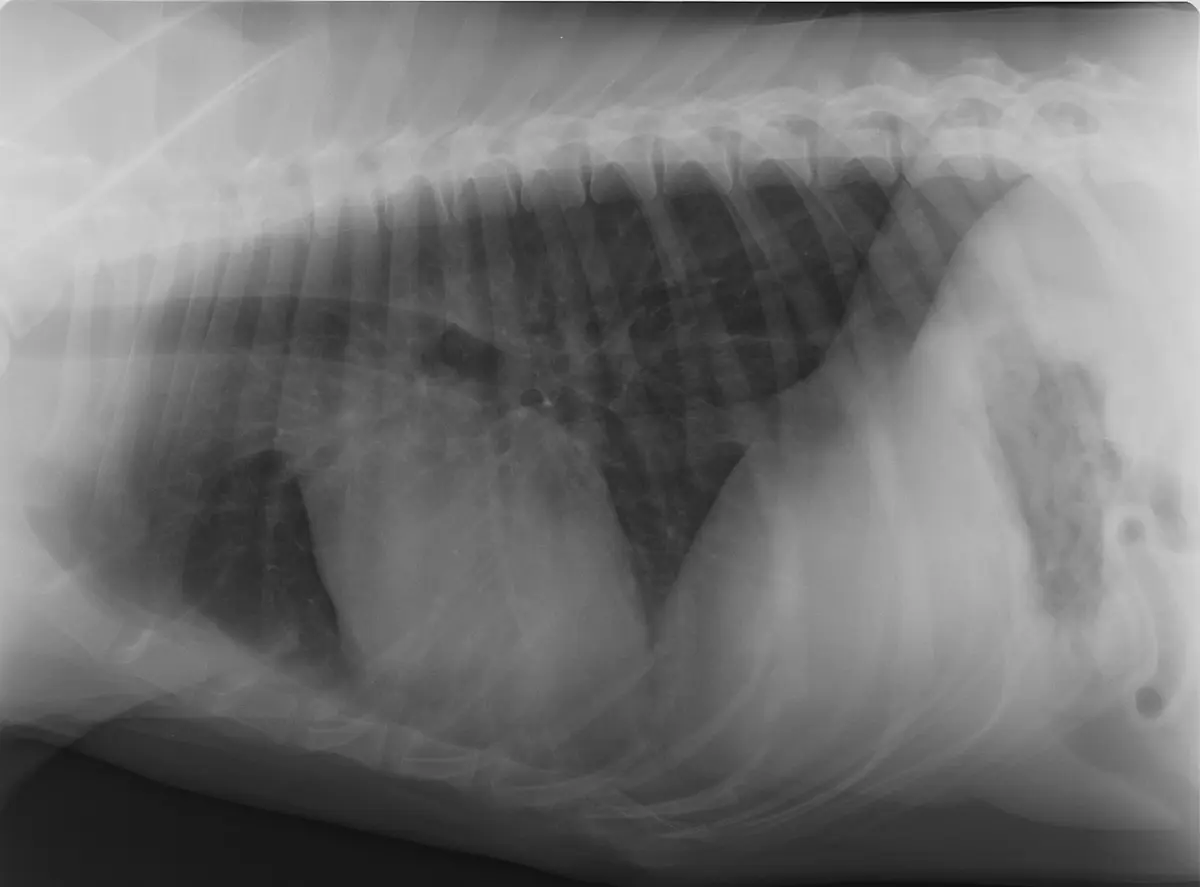
If your dog just had a chest X-ray and the report mentions "multiple pulmonary nodules," "metastatic disease," or the vivid nickname "cannonball pattern," it is completely normal for your stomach to drop. Here is the reassuring part first: this finding does not mean your time is up, and it does not mean there is nothing left to do. It usually means a cancer your dog is already being treated for, or was just diagnosed with, has reached the lungs through the bloodstream, and that changes the plan rather than ending it. Here is what the pattern actually looks like, which cancers cause it most often, why your dog may show no symptoms at all, how vets confirm and stage it, and what treatment usually involves.
What the "cannonball" pattern actually looks like
A chest X-ray is read in layers: the ribs and spine, the heart, the airways, and the lung tissue itself. Normal lung tissue looks mostly dark and lacy on an X-ray, crossed by the fine white lines of blood vessels. The cannonball pattern is a clear departure from that: multiple round, well-defined white spots scattered through both lungs, ranging from a few millimeters to a few centimeters across, looking for all the world like a scatter of small cannonballs fired into the chest.
The pattern has a specific cause. A tumor elsewhere in the body sheds cells into the bloodstream, and because essentially every drop of blood in the body eventually passes through the lungs to pick up oxygen, the lungs are usually the first place those traveling cells get caught in a small vessel and start growing. Each nodule is a tiny colony of the original tumor, which is why vets call this hematogenous, or blood-borne, spread.
- Round or oval, with a sharp, well-defined edge, unlike the soft haze of pneumonia or fluid
- Scattered through both lungs rather than confined to one lobe or airway
- Variable in size — sometimes a handful of large nodules, sometimes a fine sprinkle of tiny ones
- Does not follow the branching pattern of the airways the way an infection often does
Which cancers in dogs cause it most often
A handful of cancers account for most cases, and knowing which one your dog already has, or is being worked up for, says a lot about how likely this pattern is to turn up.
- Osteosarcoma, the most common bone tumor in dogs — chest X-rays are taken before almost any decision about a bone tumor in dogs is finalized, for exactly this reason
- Hemangiosarcoma, a tumor that most often starts in the spleen or heart; our piece on a splenic mass on ultrasound covers how that diagnosis usually begins
- Mammary gland tumors in unspayed or late-spayed female dogs
- Thyroid carcinoma
- Oral melanoma and anal sac adenocarcinoma
Nearly any malignant tumor can spread this way given enough time, which is the real reason a chest X-ray is such a routine part of working up almost any cancer diagnosis in a dog, not just the ones on this list.
Is it always cancer?
In an older dog with a known tumor elsewhere, multiple round nodules scattered through both lungs usually do mean the cancer has reached the lungs, and that is the most likely reading. It is not, however, an automatic one.
- Fungal infections such as blastomycosis, histoplasmosis, or coccidioidomycosis can produce a strikingly similar scatter of round nodules, and are far more likely in regions where those fungi live in the soil
- Old scarring or a healed area of inflammation can occasionally leave a round shadow behind
- Pulmonary osteomas, small benign bone-like nodules that form in the lung tissue, are rare but a genuine look-alike
- Septic emboli, clusters of infection carried in the bloodstream, can scatter in a similar pattern
A radiologist weighs the pattern against your dog's age, breed, travel history, and any known tumors before settling on the most likely explanation, and will usually say plainly how confident that reading is.
Why your dog might show no symptoms at all
This surprises most owners: a dog can have a lung full of metastases and still run, play, and breathe completely normally. Dogs have a large amount of spare lung capacity, and nodules can take up a surprisingly big share of the lung tissue before breathing is affected at all. The large majority of dogs have no visible spread on their chest X-ray at the time their primary tumor is first found, and even among those that do, many are still breathing comfortably — this finding is usually caught on a staging X-ray taken specifically to look for spread, not because anyone noticed trouble breathing at home.
When symptoms do show up, they tend to come late, and include a soft cough, tiring more easily on walks, faster or more labored breathing, and weight loss. None of these are specific to lung metastases on their own, which is exactly why the X-ray, not the symptoms, is what makes the diagnosis.
How vets confirm and stage it
A single X-ray view can hide a nodule behind a rib, the heart, or the diaphragm, so the standard approach is three views — both side views (left and right lateral) and one from above or below. Between the three, there are far fewer blind spots.
A nodule generally needs to reach somewhere around 6 to 9 millimeters before it reliably shows up on a plain X-ray. A CT scan of the chest sees much smaller nodules, sometimes down to just a couple of millimeters, which is why vets often recommend one before a major, irreversible surgery — an amputation for a bone tumor, for example — when the stakes of missing a small nodule are especially high. Our article on staging scans in dogs walks through this same before-treatment imaging process from a different starting point.
Biopsying an individual lung nodule is not usually necessary when a primary tumor is already known and the pattern is classic; the two pieces of information together are generally considered enough to plan treatment. A biopsy becomes more useful when the primary tumor is unknown, or when there is only a single, unusual-looking nodule that does not fit the typical picture.
Treatment options
What happens next depends heavily on which cancer is behind the pattern, and the honest answer is that lung metastases usually shift the goal from curing the cancer to managing it and protecting your dog's quality of life.
- Systemic chemotherapy, chosen to match the primary tumor (carboplatin and doxorubicin are commonly used for osteosarcoma, for example), aimed at slowing growth throughout the body, including the lungs
- Metronomic, low-dose chemotherapy — a gentler ongoing option some owners choose for its lighter side-effect profile
- Pain relief and supportive care, which matter at every stage and are never "giving up"
- Surgery to remove a lung nodule, rarely useful once the pattern is scattered through both lungs, though sometimes considered for a single, truly solitary nodule
How well any individual dog does varies with the type of cancer, how many nodules are present, and how your dog is doing overall — that conversation is best had directly with your vet or a veterinary oncologist who knows the whole picture.
Why a second read can help
How many nodules there are, how big they are, and whether a borderline shadow is really a nodule or just an overlapping rib can shift a treatment conversation considerably, and that is exactly the kind of judgment call a fast first read under time pressure can get wrong in either direction. This matters most before an irreversible decision, such as proceeding with an amputation on the assumption that the chest is clear. DocOrbit offers a veterinary radiology second opinion online: a subspecialist reviews your dog's own chest X-rays, or a CT if one was done, and writes a structured report you can bring back to your vet or oncologist. It does not replace your treating veterinarian; it gives you and your vet another careful, unhurried look at the images that matter most before a major decision is made.
Does the "cannonball" pattern on a chest X-ray always mean the cancer has spread?
Mostly, but there are exceptions. In an older dog with a known tumor elsewhere, multiple round nodules on a chest X-ray usually do mean the cancer has spread to the lungs through the bloodstream. A small number of look-alikes exist too, fungal infections in areas where they are common, old scarring, and rarely benign growths such as pulmonary osteomas can scatter similar round shadows through the lungs, which is why the picture is read alongside the rest of your dog's history rather than on its own.
How small a nodule can actually be seen on a plain chest X-ray?
A nodule generally needs to reach somewhere around 6 to 9 millimeters before it is reliably visible on a standard X-ray, and even then a nodule tucked behind a rib, the heart, or the diaphragm can be hidden on any single view. That is why vets take three images rather than one, two side views and a view from above or below, to cover those blind spots. A CT scan sees much smaller nodules, sometimes just a couple of millimeters across, which is why it is sometimes recommended before a major surgery.
Which cancers most often cause this pattern in dogs?
Osteosarcoma, the most common bone tumor, hemangiosarcoma, a tumor that often starts in the spleen or heart, mammary gland tumors, thyroid carcinoma, and oral melanoma are the ones vets see most often producing a cannonball pattern. Nearly any malignant tumor can spread this way given enough time, which is why chest X-rays are a standard part of working up almost any cancer diagnosis in a dog.
My dog has lung metastases but is not coughing or struggling to breathe, how is that possible?
This is actually the usual picture, not the unusual one. Dogs have a large amount of spare lung capacity, and nodules can take up a surprisingly big share of the lung tissue before breathing is noticeably affected. Most dogs with this finding are breathing completely normally and were found only because a chest X-ray was taken to check for spread, not because of any symptoms at home.
My vet found lung nodules before a planned surgery, does that change the plan?
Often, yes, and it is worth a direct conversation with your vet or a veterinary oncologist before anything else happens. Confirmed spread to the lungs does not usually rule out a planned surgery outright, especially one being done for pain relief rather than a cure, but it does shift the goal from potentially curing the cancer to managing it and keeping your dog comfortable, and it opens the door to chemotherapy as part of the plan.
Key takeaways
- A "cannonball" pattern is multiple round, well-defined nodules scattered through both lungs, caused almost always by cancer spreading through the bloodstream from a tumor elsewhere in the body
- Osteosarcoma, hemangiosarcoma, mammary tumors, thyroid carcinoma, and oral melanoma are the most common causes in dogs
- Most dogs show no symptoms at all when this is first found — it is usually caught on a staging X-ray taken for exactly this reason
- Three-view X-rays catch more nodules than one view, and a CT scan sees smaller ones still, which matters most before a major surgery
- Treatment usually shifts from curing the cancer to managing it, with chemotherapy and comfort care as the mainstays
How do I have my dog's chest X-ray reviewed by another veterinary radiologist online?
Yes. Online veterinary radiology second opinions run entirely from home: you upload your dog's images, with no CD to post and no second trip to a specialty clinic, and a subspecialist veterinary radiologist re-reads the study and writes a structured report you can give to your own vet. DocOrbit returns that signed second read in 24 to 48 hours, and you can message the veterinary radiologist afterward with questions about the X-ray and about what it means for your dog.
This article is for general information only and is not veterinary advice. Always discuss your animal's imaging results and next steps with a qualified veterinarian.