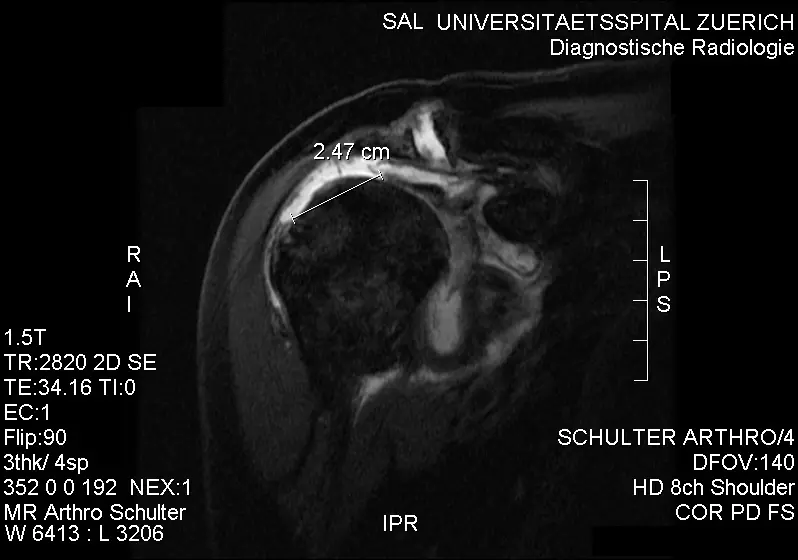
You already have the scan. Maybe the report mentions a labral tear or a partial rotator cuff tear you were not expecting, maybe your surgeon is already discussing a date for surgery and you want a second set of eyes first, or maybe you simply want your shoulder MRI re-read by a radiologist who reads shoulders all day before you decide anything. A shoulder MRI second opinion is exactly that: a board-certified musculoskeletal radiologist reviews your existing images independently and sends back a written report you can bring straight to your own doctor. Here is what a careful shoulder MRI review actually involves, why this joint rewards the extra attention, and what happens after you send your images in.
A shoulder MRI holds more than the question it was ordered to answer
A single shoulder MRI produces well over a hundred images across several sequences, T1, fat-saturated proton density or T2, sometimes an MR arthrogram series with contrast injected directly into the joint, each one weighted to bring out a different tissue. In a busy radiology department, a general radiologist works through that stack alongside a full day of chest X-rays, abdominal scans, and everything else on the list, under real time pressure. The read is optimized to answer the specific clinical question on the request form, confirm a suspected rotator cuff tear after a fall, check for instability after a dislocation, not to comb every image for everything that could conceivably be there.
Small or borderline findings, a low-grade partial-thickness tear tucked on the undersurface of the supraspinatus tendon, a subtle posterior labral tear that is easy to read as a normal variant, are exactly the kind of thing a fast first read is not looking for. None of this is a comment on any individual radiologist's competence; it is what volume and time do to any read, however skilled the person doing it. A slower, dedicated shoulder MRI second read of the same images is what buys back the attention the first pass did not have room for.
Why a musculoskeletal radiologist reads a shoulder MRI differently
A general radiologist reads everything, chest, abdomen, bone, brain, often in the same shift. A musculoskeletal (MSK) radiologist reads joint and soft-tissue imaging all day, every day, often for years, and that concentration changes what jumps out. Someone who has looked at thousands of rotator cuffs recognizes a thin, undersurface partial tear that could easily be read as tendinosis. Someone who reads shoulder MR arthrograms constantly is faster to separate a genuine labral tear from the normal sublabral recess that mimics one.
This is the whole logic behind having your shoulder MRI re-read by another radiologist who specializes in joints rather than a general reader: not carelessness on the first read, but that a narrower, deeper field of view statistically catches things a broad one is more likely to under-call. The same reasoning applies to our knee MRI second opinion coverage, since shoulders and knees are read by the same MSK subspecialty.
What a shoulder MRI actually shows, structure by structure
A thorough shoulder MRI interpretation works through the same anatomy an MSK radiologist is trained to check on every study, structure by structure:
- The rotator cuff — the supraspinatus, infraspinatus, subscapularis and teres minor tendons are checked for a rotator cuff tear or tendinosis, how far a torn tendon has retracted, and whether the muscle behind it has started to atrophy
- The labrum — the ring of cartilage rimming the socket is checked for a SLAP tear at its top, where the biceps tendon attaches, or a Bankart lesion at the front and bottom, the labral injury that often follows a shoulder dislocation
- The biceps tendon — the long head of the biceps, which runs through the joint before it dives into a bony groove, is checked for tendinosis, a tear, or instability out of that groove
- The glenohumeral joint and cartilage — the smooth cartilage lining the ball and socket is graded for thinning or loss, an early sign of wear that can progress to osteoarthritis, along with any joint effusion or loose fragment
- The acromioclavicular (AC) joint — the small joint on top of the shoulder is checked for arthritis and bone spurs that can narrow the space the rotator cuff passes through
- The subacromial-subdeltoid bursa — the cushioning sac above the rotator cuff is checked for fluid and thickening, the imaging signature of bursitis and shoulder impingement
- Bone and marrow — the humeral head is checked for a Hill-Sachs lesion, the dent left behind by a dislocation, along with bone marrow edema from a recent injury or, less commonly, osteonecrosis
- The joint capsule — capsular thickening and a shrunken axillary recess are the imaging signs radiologists look for in adhesive capsulitis, better known as frozen shoulder
One honest limit is worth stating plainly: a standard shoulder MRI without contrast is good at the rotator cuff and the bursa, but its sensitivity for a subtle labral tear or early instability is lower than an MR arthrogram, where contrast injected directly into the joint distends it and outlines the labrum clearly. If the clinical question is instability or a suspected labral tear specifically, an MR arthrogram is the better test, not something a standard shoulder MRI review can substitute for. A careful shoulder MRI interpretation says so directly rather than implying the scan settled a question it was never built to answer.
How DocOrbit reads your shoulder MRI
Upload your shoulder MRI online for a second opinion, the DICOM files from the scan or a copy of the disc you were given, and a board-certified musculoskeletal radiologist performs a full shoulder MRI second read, going through the same structures one at a time, from the rotator cuff to the labrum to the joint capsule, and writes a structured report you can hand directly to your own doctor or surgeon. Nothing here is guesswork about what your files contain, it is the same volume of images your original scan produced, read again by someone whose whole practice is joints and soft tissue. The signed report comes back in 24-48 hours, and it is not a comment on the first read being wrong, it says only what a fresh, focused shoulder MRI review found, in the same clinical language your physician already speaks.
Get your shoulder MRI re-read by a subspecialist
Ask the radiologist questions afterward
One thing that surprises most patients: the second opinion does not end when the report lands in your inbox. Once you have it, you can ask a radiologist online, messaging the musculoskeletal radiologist directly about a phrase in the report, about whether a finding is really what is causing your pain, or about what to ask your orthopedic surgeon next, and get a written answer back. Most people never get the chance to ask the person who actually looked at their images anything at all. A second opinion on a shoulder MRI is built around that conversation rather than treating the report as the last word.
Or get an answer in minutes with Orbius
If waiting 24-48 hours for a signed subspecialist report is not what you need right now, DocOrbit also offers Orbius, an AI radiology agent built for exactly this kind of online radiology second opinion. It reads the same shoulder MRI and returns a structured report, findings, impression, next steps, in minutes rather than days, at a lower cost, any time of day. It is a genuinely honest trade: speed and price against a human subspecialist's training and signature. If the Orbius report raises something worth a specialist's opinion, or you simply want more confidence before a surgery decision, upgrading to a full MSK radiologist read from the same upload is one click away.
How do I send my shoulder MRI for a second opinion?
Upload the DICOM files from your scan, or the CD you were given at the imaging center, directly through the DocOrbit platform. Nothing needs to be mailed or dropped off anywhere, the images go straight to the radiologist reviewing your case.
Do I need the actual MRI images, or is the written report enough?
You need the images themselves, not just the written report. A genuine second opinion means a radiologist looks at your shoulder MRI directly, the same way the first one did, rather than reviewing someone else's description of what they saw.
Will my orthopedic surgeon accept a second opinion report?
Yes. The report follows the same structured format radiologists use everywhere, with findings and an impression your orthopedic surgeon or primary doctor can read and act on like any other radiology report, and you are free to share it with them directly.
How long does a shoulder MRI second opinion take?
A signed report from a board-certified musculoskeletal radiologist typically comes back in 24 to 48 hours. If you want an answer sooner, Orbius, DocOrbit's AI radiology agent, returns a structured report on the same images in minutes.
Is it worth getting a second opinion before shoulder surgery, or if my MRI was reported as normal?
Both situations are common reasons patients ask for one. Before a scheduled surgery, a second read confirms that the imaging genuinely supports the plan; if the scan came back normal but the shoulder still hurts, a fresh, unhurried review sometimes catches a subtle finding, such as a small undersurface cuff tear or a labral tear, that a fast first read passed over, or confirms that normal really does mean normal.
Key takeaways
- A shoulder MRI produces well over a hundred images across several sequences, more than a single fast read is built to fully comb
- An MSK radiologist reads joints and soft tissue exclusively, and catches patterns a generalist covering every body part is more likely to under-call
- A proper shoulder MRI review walks the same anatomy structure by structure, from the rotator cuff and labrum to the biceps tendon, joint and bone marrow
- A standard shoulder MRI is not the same test as an MR arthrogram; instability and subtle labral tears sometimes need the arthrogram specifically
- DocOrbit's signed MSK radiologist read takes 24-48 hours; Orbius, the AI option, returns a structured report in minutes
- You can message the radiologist with questions after the report arrives
Can I get a second opinion on my MRI online?
Yes. Online radiology second opinions run entirely from home: you upload your images, with no CD to post and no second trip, and a subspecialist radiologist re-reads the study and writes a structured report you can give to your own doctor. DocOrbit returns that signed second read in 24 to 48 hours, and you can then message the radiologist with questions about the MRI and about what the report actually means for you.
This article is for general information only and is not medical advice. Always discuss your imaging results and any next steps with a qualified physician.