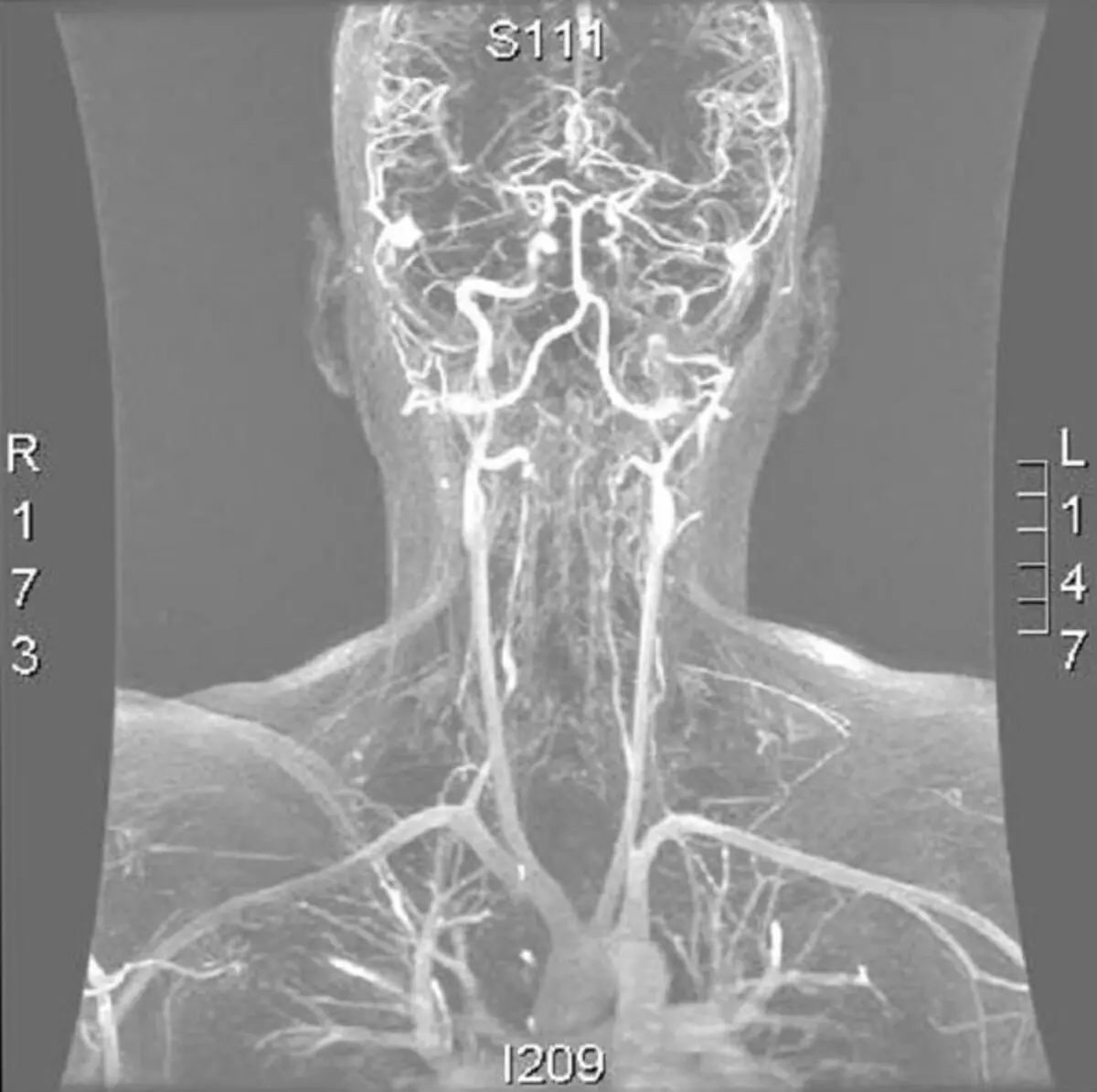
Yes, for the vast majority of patients, MRI contrast is safe. The dye used in an MRI, a gadolinium-based contrast agent (a metal compound bound tightly to a carrier molecule, given through an IV line), causes side effects in only a small fraction of people, and serious reactions are rare. The two questions actually worth understanding are who needs extra caution, mainly people with significant kidney disease, and what happens to the contrast in your body afterward. Here's the honest version of both.
What's actually in the injection
MRI contrast isn't the same as the iodine-based dye used in a CT scan; it's a different chemical with its own safety profile. It's built around gadolinium, a metal that would be toxic on its own, so before it ever reaches a vein it's tightly bound to a carrier molecule, a process called chelation.
Once inside the scanner's strong magnetic field, it changes how nearby water molecules respond to the MRI's radio pulses, making blood vessels, inflamed areas, and many tumors show up brighter and easier to see. It doesn't emit radiation itself, and neither does the scan; MRI as a whole works without radiation, a separate question our guide to MRI and radiation covers in more depth. With normal kidney function, the kidneys clear the entire dose within about a day.
The one group who needs real caution: kidney disease
In the mid-2000s, doctors linked a small number of gadolinium-based agents to nephrogenic systemic fibrosis (NSF), a rare but serious condition that thickens skin and connective tissue. It showed up almost exclusively in patients with severe, advanced kidney failure, particularly those on dialysis, whose kidneys couldn't clear the contrast quickly enough for it to stay safely bound.
In response, newer, more stable agents (macrocyclic agents) have largely replaced the higher-risk older ones, and anyone with known kidney problems now gets a blood test for kidney function before contrast is approved. Reported NSF cases have fallen to close to zero since. If your kidney function is reduced but not severely, you can usually still have contrast, sometimes at a lower dose.
Does the gadolinium stay in your body
Since around 2014, researchers have known that trace amounts of gadolinium remain in brain tissue after multiple contrast MRIs, even in people with completely normal kidneys. It sounds alarming until you see the scale: the amount retained after a handful of scans is measured in millionths of a gram, roughly the mass of a single grain of table salt spread across your entire body.
No study has yet tied that retained gadolinium to any confirmed symptom or illness in people with normal kidney function. Regulators still updated safety labeling, and most radiology departments now favor the agents shown to leave the smallest trace behind. It's an active area of research, not a settled harm, and one more reason contrast is used only when it will genuinely change what the scan can show.
Allergic reactions, and who should speak up first
Most people feel nothing beyond a brief cool sensation as the contrast goes in. When a reaction does happen, it's usually mild, a wave of warmth, a bit of nausea, a passing headache, and it resolves on its own within minutes. Reactions serious enough to need treatment are uncommon, and severe reactions are rarer still.
If you've reacted to contrast before, have a significant history of allergies or asthma, or aren't sure about your kidney function, tell the technologist before the injection, not after; it changes what the team prepares for. Whatever the scan shows, how carefully it gets read matters just as much as how safely it was given. If a report leaves you with more questions than answers, an independent second radiological opinion from a subspecialist, the kind of service DocOrbit provides within a day or two, can review the same images without another scan.
Can I have MRI contrast if I have kidney disease?
It depends on how severe. Mild to moderate kidney impairment isn't usually a barrier, but significantly reduced function or dialysis means your radiologist checks your eGFR first and may choose a lower-risk agent, a lower dose, or skip contrast entirely.
Is MRI contrast safe during pregnancy or while breastfeeding?
Contrast is generally avoided in pregnancy unless it would clearly change your care, since gadolinium crosses the placenta and its long-term fetal effects aren't fully established. Breastfeeding is different: major radiology societies consider it safe to keep nursing afterward, since only a tiny trace reaches breast milk.
What are the most common side effects of MRI contrast?
Most people feel nothing beyond a brief coolness at the injection site. When side effects happen, they're usually mild, a headache, mild nausea, or a metallic taste, passing within minutes. Serious allergic-type reactions are uncommon, and every MRI suite is equipped to manage one immediately.
Do all MRIs require contrast?
No. Many MRIs, including most spine, joint, and initial brain scans, are read perfectly well without any contrast. Your radiologist adds it when it will make a real difference, such as highlighting a tumor's blood supply, not as a routine add-on.
Key takeaways
- MRI contrast (gadolinium) is safe for the large majority of patients, with side effects in only a small fraction
- Significant kidney disease is the main reason for extra caution, because of a rare condition called NSF
- Trace gadolinium can remain in the body after multiple scans, with no confirmed harm in people with normal kidney function
- Serious allergic-type reactions are rare, and every MRI suite is prepared to treat one
- Contrast is used only when it adds real diagnostic value, not as a routine add-on
Can I get a second opinion on my MRI online?
Yes. Online radiology second opinions run entirely from home: you upload your images, with no CD to post and no second trip, and a subspecialist radiologist re-reads the study and writes a structured report you can give to your own doctor. DocOrbit returns that signed second read in 24 to 48 hours. You can then message the radiologist with questions about the MRI and about what the report actually means for you.
This article is for general information only and is not medical advice. Always discuss your imaging results and any next steps with a qualified physician.