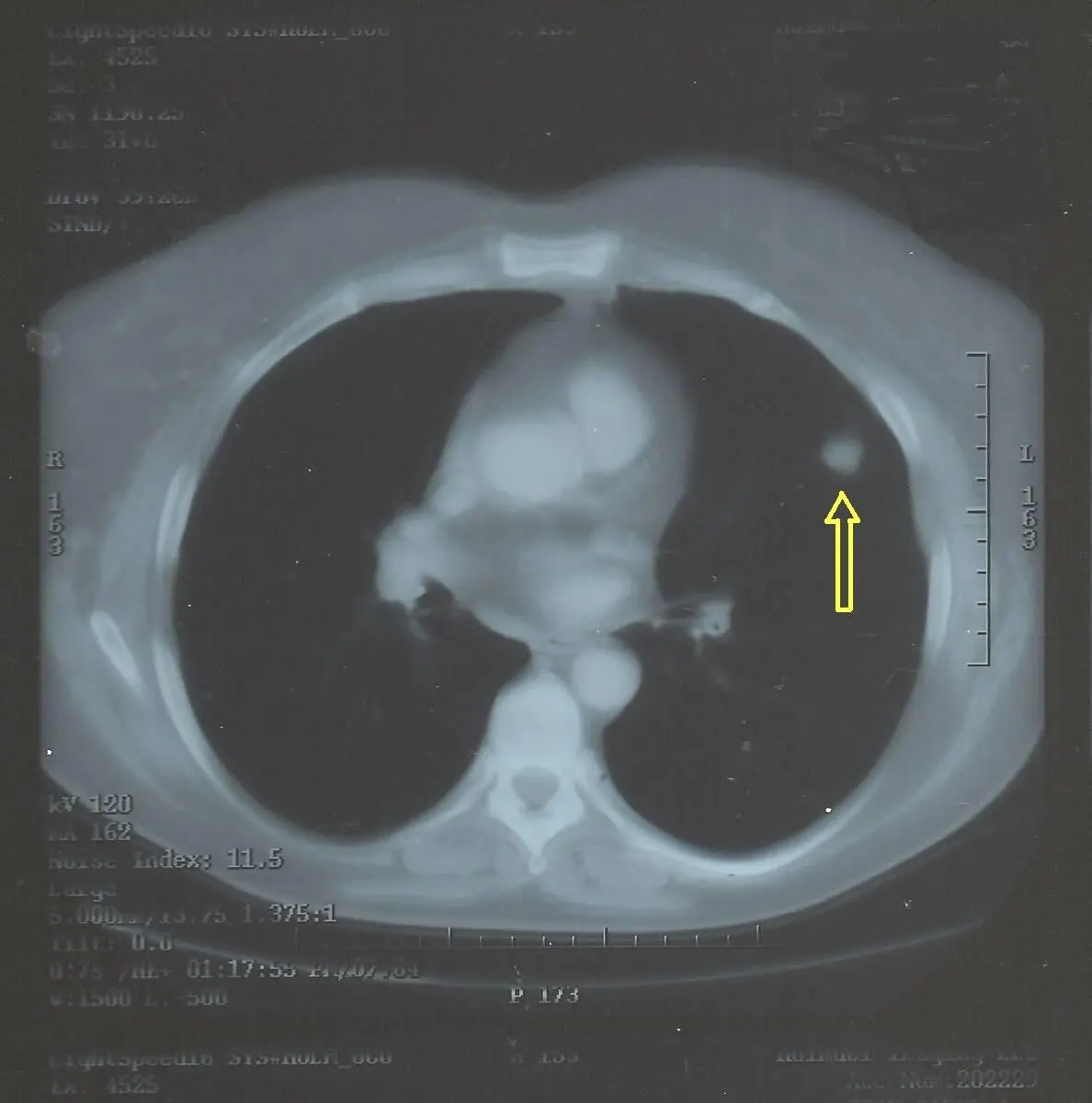
In the large majority of cases, no. A lung nodule spotted on a CT scan or chest X-ray is usually a small patch of old scar tissue, a healed infection, or a cluster of benign cells, not a tumor. Large studies of CT scans done for any reason put the odds of a small, incidentally found nodule turning out to be cancer at well under 5%. What actually shifts those odds is the nodule's size, whether it grows on a follow-up scan, and personal risk factors like smoking history and age, and that's where the real answer lives.
What exactly is a lung nodule?
A nodule is radiology shorthand for a small, roughly round spot on a scan that looks different from the surrounding lung tissue, usually smaller than 3 centimeters, about the size of a golf ball. Anything larger gets called a mass instead and is treated with more urgency, since size alone raises the odds of something serious. Most nodules are actually found by accident, on a CT ordered for something else entirely, like a car accident workup or a check for kidney stones, because a CT scan (a detailed 3D X-ray) sees far more detail than a plain chest X-ray.
What actually decides whether it's worth worrying about
Size is the single biggest factor. A 4-millimeter nodule, smaller than a grain of rice, carries a cancer risk close to zero. An 8-millimeter nodule, about the size of a pea, gets a closer look. Past 3 centimeters, roughly golf-ball size, it's no longer called a nodule at all, it's a mass. Beyond size, radiologists weigh the edges (smooth and round is reassuring, spiky or irregular, called "spiculated," is more suspicious) and, above all, whether the nodule changes on a follow-up scan. A nodule that looks identical two years apart is about as reassuring as imaging gets; smoking history, age, and family history shift how closely any given nodule gets watched.
How follow-up actually works
Most radiologists follow guidance from the Fleischner Society, a group of thoracic radiologists who publish evidence-based follow-up intervals by nodule size and risk. As a rough guide, not a personal recommendation, since your own doctor applies this to your scan: nodules under 6 mm in a low-risk patient often need no follow-up at all, ones 6–8 mm typically get a repeat CT in 6 to 12 months, and larger or suspicious-looking ones may move to a PET-CT (a scan that shows whether tissue is unusually active, since cancer cells tend to burn more sugar than normal tissue, covered in our guide to PET-CT and hypermetabolic findings) or a needle biopsy for an actual tissue sample. Even among nodules worked up this thoroughly, only a minority turn out to be cancer.
If your own report already describes a nodule, our guide on what to do after a lung nodule shows up on your CT scan walks through the next steps in more detail, and a subspecialist second read from a service like DocOrbit, typically back in 24–48 hours, can double-check the size, margins, and Fleischner category before you and your doctor decide.
How common are lung nodules on a CT scan?
Very common. Chest CTs done for any reason turn up a nodule in roughly a quarter to half of scans, especially in current or former smokers over 50. The large majority are never anything more than an old scar or a healed spot of inflammation.
What size lung nodule is considered concerning?
There is no single cutoff, but nodules under 6 mm are usually considered low risk, while ones over 8 mm, or ones that grow on a follow-up scan, get closer attention. Growth over time matters more than the size on any single scan.
Does every lung nodule need a biopsy?
No. Most nodules are simply watched with a follow-up CT at an interval set by size and risk factors. A biopsy is reserved for nodules that are large, growing, or have features that look suspicious on imaging.
Can a lung nodule go away on its own?
Yes, particularly nodules caused by infection or inflammation, which can shrink or disappear completely on a repeat scan weeks or months later. That is one reason doctors often recommend a follow-up scan before assuming a nodule is permanent.
Key takeaways
- Most lung nodules are not cancer, well under 5% overall
- Size, growth on follow-up scans, and risk factors like smoking and age drive the level of concern, not the word "nodule" itself
- Fleischner Society guidelines set the standard follow-up intervals your doctor applies to your scan
- A nodule that needs a closer look moves to PET-CT or biopsy, not automatically to a cancer diagnosis
This article is for general information only and is not medical advice. Always discuss your imaging results and any next steps with a qualified physician.