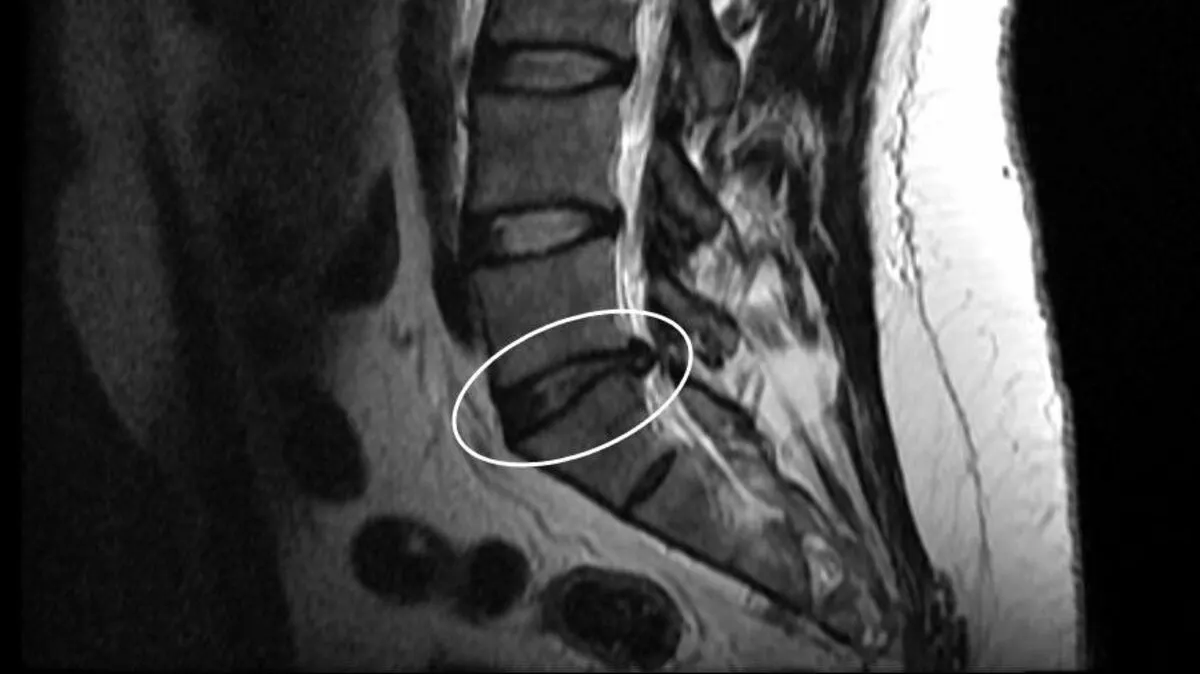
No. A herniated disc — the soft, gel-like center of a spinal disc pushing out through a tear in its tougher outer layer — does not always cause back pain, and a large share of people who have one show nothing on a physical exam at all. What decides whether it hurts is mostly whether the herniation is pressing on or irritating a nearby nerve, not how large it looks on the scan. Here is how common a painless herniated disc really is, why some herniations hurt and others don't, and what to do if a report finding and your own symptoms don't seem to line up.
How common is a herniated disc with no pain at all?
More common than most patients expect. One of the most cited studies on this, a 2015 review of MRI and CT scans from thousands of adults who had never had back pain, found disc bulges in roughly a third of pain-free people in their 20s, rising to the large majority of pain-free people by their 80s. Actual herniations, a more focal type of bulge sometimes labeled a protrusion, showed up less often but were still present in roughly a quarter to a third of pain-free adults at every age studied from 20 upward, according to the same systematic review.
That is one reason a disc herniation found on MRI is never treated as an automatic diagnosis by itself — the finding has to line up with where and how a person actually hurts.
Why some herniated discs hurt and others don't
Pain comes mostly from pressure or chemical irritation on a nerve root, the bundle of nerve fibers exiting the spine at each level, not from the herniation simply existing. Picture the spinal canal as a hallway and the nerve roots as people walking through it: a herniation that bulges into open space can miss every nerve on its way through, while a smaller one in a narrower stretch of that same hallway can pin a nerve directly against bone. Location and how much room a nerve has at that level matter more than the size of the herniation written on the report.
This is also why a degenerative disc and a herniation so often turn up on the same report — years of wear narrow that hallway, which is one reason an older disc is more likely to herniate into a tight space than a younger one is.
What the pain usually feels like when a herniation does cause it
When a herniation does press on a nerve root, the pain is often more specific than plain back pain: a sharp or burning line running down one buttock and leg, commonly called sciatica, sometimes with numbness, tingling, or a leg that feels weaker than usual. Pain confined to the lower back alone, with no leg symptoms, is less specific and less often explained by a single herniation. Coughing, sneezing, or sitting for a long stretch can make nerve-related pain worse, because each briefly raises pressure inside the spinal canal.
What to do if the report and your symptoms don't match
A herniated disc on a scan is only the start of the story. A doctor confirms it as the actual cause of pain by checking whether the level and side of the herniation match where the pain, numbness, or weakness actually shows up. If your symptoms don't seem to line up with what the report describes, or you would simply like another set of eyes on the images themselves rather than just the wording of the report, an online radiology second opinion lets a subspecialist radiologist review the actual scan and put a clear answer in writing for your own doctor.
Can a herniated disc heal on its own without surgery?
Yes, in the large majority of cases. Most herniated discs shrink or stop irritating the nerve within weeks to a few months with rest, physical therapy, and anti-inflammatory medication, and surgery is reserved for the smaller share of people whose pain, numbness, or weakness does not improve or gets worse.
Does the size of a herniated disc on MRI predict how bad the pain will be?
Not reliably. A large herniation that bulges into open space around the nerve can be painless, while a small one in a tight spot can press directly on a nerve root and hurt a great deal. Doctors weigh the exam and symptoms alongside the image rather than the size of the herniation alone.
Is it normal for an MRI to show a herniated disc if I have never had back pain?
Yes. Studies of people with no back pain at all regularly find disc bulges and even outright herniations on their scans, more often as people get older, so an incidental herniation found for an unrelated reason is common and does not necessarily need treatment.
Can I ask a radiologist about my MRI report online?
Yes. You upload your images or your written report from home, and a subspecialist radiologist reviews the actual scan and writes a structured report you can share with your own doctor, usually within 24 to 48 hours. You can message the radiologist afterward with questions about what the herniation means for you specifically.
Key takeaways
- A herniated disc shows up on the scans of a meaningful share of pain-free people, more often with age.
- Whether it hurts depends on whether it presses on or irritates a nerve, not on its size on the report.
- Pain from a herniation often radiates down a leg as sciatica rather than staying in the back alone.
- Most herniated discs that do cause pain improve without surgery within weeks to a few months.
- Your own doctor matches the scan finding to your exam and symptoms before treating it as the cause of your pain.
This article is for general information only and is not medical advice. Always discuss your imaging results and any next steps with a qualified physician.