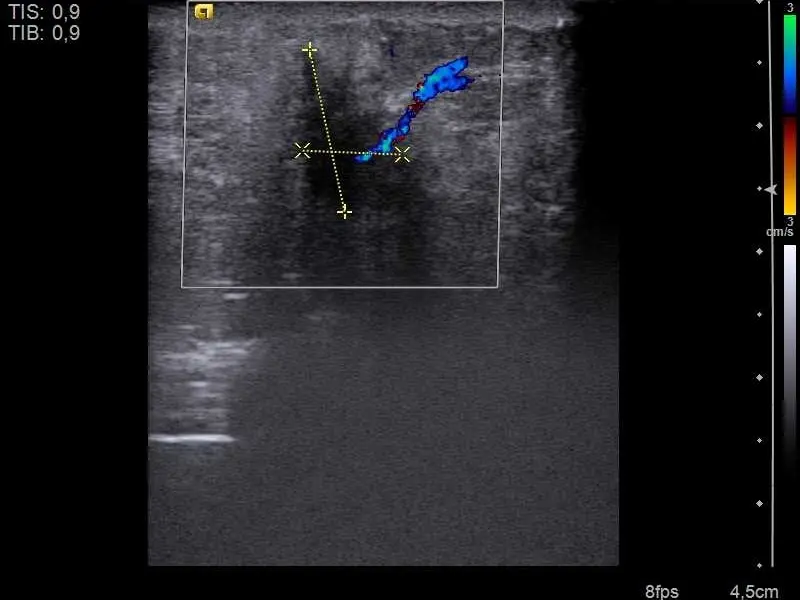
Yes. Ultrasound can detect many cancers, and for a few organs, the thyroid, the breast, the testicle, it's usually the very first scan a doctor orders to look for one. But it works far better in some parts of the body than others, and like every imaging test, it can show that something looks suspicious without being able to prove it is cancer. Here is where ultrasound is genuinely strong, where it struggles, and what usually happens after it finds something worth a closer look.
Where ultrasound sees cancer well
Ultrasound builds a live, moving picture from sound waves bounced off tissue, no radiation involved, which is why it's used so freely. It works best on organs it has a clear path to reach:
- Breast tissue, especially in younger or denser breasts where a mammogram alone is less reliable
- The thyroid gland, where most nodules are found incidentally on ultrasound done for another reason
- The testicle, where ultrasound is the first and usually only imaging test needed
- Superficial or enlarged lymph nodes in the neck, armpit, or groin
- The liver, kidney, and ovary, where it's frequently the first scan ordered
With Doppler, a mode that colors in blood flow on the same image, a radiologist can also see how much blood supply a mass has, since many cancers grow a messier, richer blood supply than the tissue around them.
Why ultrasound can't see everywhere
Sound waves travel cleanly through soft, fluid-rich tissue, but they reflect almost entirely off bone and air, the way a flashlight beam stops dead at a mirror instead of lighting up what's behind it. That is why ultrasound is essentially blind inside the lungs, which are mostly air; a lung nodule is a CT finding, not an ultrasound one. It is also why ultrasound cannot look through an adult skull for a brain tumor, or reliably see past gas-filled bowel loops deep in the abdomen. In a larger body, sound travels through more tissue in both directions, which softens the picture too.
What a suspicious finding on ultrasound actually means
A radiologist reading an ultrasound weighs a mass's shape, its margins (how sharp or blurred its edges are), and its blood flow to sort a finding as reassuring, indeterminate, or suspicious. Breast findings use a scale called BI-RADS; thyroid nodules use TI-RADS. Neither category is a diagnosis. As with an MRI or any other scan, "suspicious" describes a probability, not a confirmed result, and only a biopsy, taking a small tissue sample and examining it under a microscope, actually confirms cancer one way or the other.
What happens after a suspicious ultrasound
The next step depends on the organ and how suspicious the features look. A thyroid nodule with worrying features is often biopsied directly under ultrasound guidance, right there in the same visit. A breast finding usually adds a mammogram and sometimes an MRI before any biopsy is scheduled. A kidney or liver mass often goes to a CT or MRI first, for a more detailed look before anyone talks about tissue sampling. This is also a good point for an online radiology second opinion: DocOrbit's subspecialist radiologists review the same images from home and either confirm the impression or flag what the first read underplayed.
Can ultrasound tell the difference between a benign and a malignant lump?
Often, to a useful degree, but not with certainty. Features like a smooth round shape and no internal blood flow point toward benign; an irregular shape, blurred margins, and rich blood flow point toward suspicious. Many findings still fall in a gray zone that only a biopsy can resolve.
Is a normal ultrasound enough to rule out cancer?
It's reassuring but not absolute. A normal ultrasound means no suspicious mass was seen in the area actually scanned, with a technique that has real blind spots behind bone, gas, and deep tissue. Persisting symptoms can still warrant a different scan or follow-up.
Why would a doctor order a CT, MRI, or biopsy instead of just an ultrasound?
Each test answers a different question. CT and MRI see through bone and gas and give a more detailed, three-dimensional picture of size and spread; a biopsy is the only test that looks at actual cells. Doctors add whichever one answers the specific question the ultrasound couldn't.
Key takeaways
- Ultrasound detects many cancers well, especially in the breast, thyroid, testicle, and superficial lymph nodes
- It can't see through bone, air, or gas, so lungs, an adult skull, and deep bowel are largely out of reach
- A suspicious finding describes probability, not a diagnosis; a biopsy is usually what confirms cancer
- A normal ultrasound is reassuring but doesn't rule out cancer with total certainty
- CT, MRI, and biopsy each answer questions ultrasound alone cannot
Can I ask a radiologist about my ultrasound report online?
Yes. You upload your images from home, no CD to post and no second trip, and a subspecialist radiologist reviews the study and writes a structured report you can hand to your own doctor within 24 to 48 hours. You can message the radiologist with questions about the ultrasound and what the findings actually mean afterward.
This article is for general information only and is not medical advice. Always discuss your imaging results and any next steps with a qualified physician.