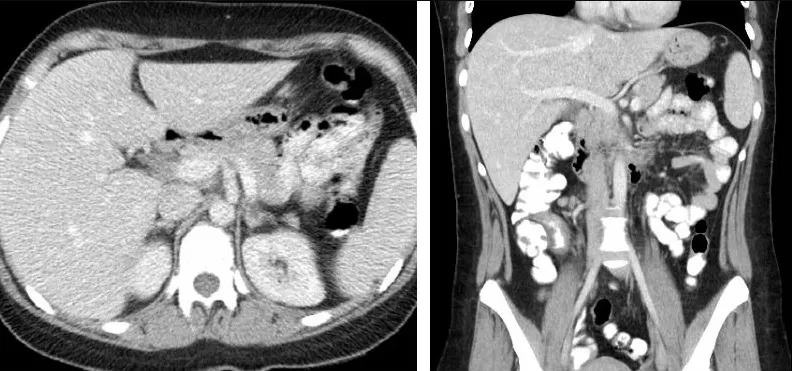
You went in for a CT scan of your belly, your kidney stones, or your chest, and the report came back with a line about a small nodule on one of your adrenal glands. You were not even scanned for that. The good news first: in people without a known cancer, the overwhelming majority of these nodules are harmless, and they are found so often that radiologists have a name for them.
What "adrenal incidentaloma" actually means
The two adrenal glands are small, triangle-shaped organs that sit like caps on top of each kidney, deep in the back of your abdomen. They make hormones that help control blood pressure, salt balance, and your response to stress. An "incidentaloma" is simply a nodule found on the adrenal gland by accident, on a scan done for a completely different reason. The word bundles two ideas: incidental (nobody was looking for it) and -oma (a growth or lump).
Adrenal nodules are common, and they become more common with age. They turn up on a meaningful share of abdominal CT scans, especially in older adults. Finding one is usually a statement about how good modern scanners are, not a sign that something is wrong.
Common causes
- Adrenal adenoma — a benign, non-cancerous overgrowth of normal adrenal tissue. This is by far the most common answer.
- Myelolipoma — a harmless nodule made of fat and blood-forming tissue, easy to recognize on CT because of its fat content.
- Adrenal cyst or hemorrhage — a fluid pocket or an old bleed, usually of no consequence.
- Hormone-producing nodule — a smaller fraction that quietly makes extra cortisol, aldosterone, or adrenaline-type hormones.
- Metastasis — a deposit from a cancer elsewhere. This is mainly a concern in people who already have a known cancer, not in the general population.
Is it serious?
For most people, no. Two questions drive everything that follows: does the nodule look benign on imaging, and is it making hormones it should not. Radiologists judge the first using CT density (measured in Hounsfield units) and how quickly contrast washes out. A low-density nodule that behaves like a classic adenoma is very reassuring. The features that prompt a closer look are large size (typically over 4 cm), an irregular or growing appearance, and a background of known cancer elsewhere in the body.
This is a bit like the way a small kidney or pancreatic finding is handled — most are benign and simply watched, while a minority get worked up further. If you have read about a renal cyst on ultrasound or a pancreatic cyst on MRI and CT, the logic here will feel familiar: describe it, decide if it looks benign, and check whether it needs any follow-up at all.
Symptoms
By definition, an incidentaloma is found without symptoms — that is the whole point. Most people feel completely normal. When a nodule does make extra hormones, the clues are indirect: hard-to-control high blood pressure, low potassium, easy bruising, weight gain around the middle, or episodes of racing heart and sweating. Your doctor screens for these with simple tests rather than waiting for symptoms to appear.
How it is worked up
The evaluation has two tracks that run in parallel. First, an imaging assessment: is a dedicated adrenal-protocol CT or MRI needed to confirm the nodule is benign, and does it need a repeat scan in 6 to 12 months to show it is stable. Second, a hormone assessment: blood and urine tests to rule out excess cortisol, aldosterone, or catecholamines. Many nodules need only one round of this and are then left alone. Guidelines from bodies such as the American College of Radiology and endocrine societies frame these steps, but the exact plan depends on your age, the imaging features, and your other health history.
Treatment options
The honest answer for most adrenal incidentalomas is that no treatment is needed at all — they are simply monitored, and often not even that after they are confirmed stable and non-functioning. Surgery to remove the gland is reserved for nodules that are large, look atypical, grow over time, or produce enough hormone to affect your health. When surgery is the right call, it is usually a well-established, minimally invasive operation.
Why a second read can help
Adrenal nodules live in a gray zone where the exact numbers on the CT — density, washout, size, and change over time — decide whether you need nothing, a repeat scan, or a full endocrine workup. Those measurements reward a careful, subspecialty eye. An expert second read from DocOrbit gives you an independent radiology opinion you can bring to your own doctor, so you can be confident the plan matches what the images actually show. If you are unsure whether your finding warrants one, our guide on incidental findings and follow-up walks through how these decisions are usually made.
Is an adrenal incidentaloma cancer?
In people with no history of cancer, the large majority of adrenal incidentalomas are benign adenomas that never cause a problem. Primary adrenal cancer is rare. The imaging features, the size, and whether you have a known cancer elsewhere are what decide how closely it is looked at.
What size of adrenal nodule is concerning?
Small nodules under about 4 cm with clearly benign features are usually reassuring. Nodules larger than 4 cm, or ones that grow on follow-up or look atypical on CT, are the ones doctors evaluate more carefully. Size alone is only one part of the picture.
Do I need surgery for an adrenal nodule?
Most adrenal nodules are simply monitored and never need surgery. Removal is usually considered when a nodule is large, has worrying imaging features, is clearly growing, or is producing too much hormone. Your endocrinologist and surgeon weigh those factors together.
Why do I need blood and urine tests for an adrenal nodule?
A small fraction of adrenal nodules quietly make extra hormones such as cortisol, aldosterone, or adrenaline-type hormones. Simple blood and urine tests check for this, because a hormone-producing nodule can affect blood pressure, potassium, and metabolism even when it is small.
Key takeaways
- An adrenal incidentaloma is a nodule found by chance on a scan done for another reason — extremely common and usually benign.
- Two questions drive the workup: does it look benign on imaging, and is it making extra hormones.
- Most are simply confirmed stable and left alone; surgery is reserved for large, atypical, growing, or hormone-producing nodules.
If the rest of your report reads like another language, our free radiology report explainer rewrites it in everyday words, defines the terms it uses and suggests what to ask at your next appointment.
Can I get a second opinion on my CT online?
Yes. Online radiology second opinions run entirely from home: you upload your images, with no CD to post and no second trip, and a subspecialist radiologist re-reads the study and writes a structured report you can give to your own doctor. DocOrbit returns that signed second read in 24 to 48 hours. You can then message the radiologist with questions about the CT and about what the report actually means for you.
This article is for general information only and is not medical advice. Always discuss your imaging results and any next steps with a qualified physician.