You already have the scan. Maybe your doctor ordered it for a closer look at something spotted on an earlier ultrasound or CT, as part of working up pelvic pain, or as a routine surveillance study for a chronic liver condition. Maybe the report used an unfamiliar term, or came back reassuring and you'd still like a second, unhurried look before filing it away. An abdomen and pelvic MRI second opinion, sometimes called a body MRI second opinion, is exactly that: a board-certified body radiologist reviews your existing images independently and sends back a written report you can bring straight to your own doctor. Here's what that second read actually covers, why this particular scan rewards the extra attention, and what happens after you send it in.
An abdomen and pelvic MRI runs through more sequences than a quick scroll can absorb
A single abdominal and pelvic MRI isn't one set of images, it's several. A typical exam moves through five or more separate sequences of the same anatomy: T1-weighted and T2-weighted images, a fat-suppressed series that makes fluid and inflammation stand out, in-phase and opposed-phase images that reveal fat content inside a lesion, diffusion-weighted images that flag restricted water movement, and often a dynamic series before and after contrast to watch how tissue enhances over several minutes. That adds up to many hundreds of images from a single appointment. In a busy radiology department, or an overnight teleradiology shift covering several hospitals at once, a study like this is still typically read in well under half an hour, because the volume moving through the department doesn't slow down for any one case.
That kind of read is very good at answering the one clinical question the scan was ordered to settle. It has less room for a small, quiet finding that had nothing to do with why the scan was ordered — a few-millimeter adrenal nodule, a renal cyst a little more complex than it first looks, a subtle signal change in the liver on the fat-suppressed sequence. None of that reflects the skill of the radiologist reading quickly under real pressure, it reflects what volume and time do to a read built from this many sequences. A slower, dedicated second read of the same images buys back the attention the first pass didn't have time for.
Why a body radiologist reads an abdominal MRI differently
A general radiologist reads everything that comes through in a single shift, chest CTs, mammograms, musculoskeletal MRIs, and abdominal and pelvic MRIs side by side. A body radiologist, sometimes called an abdominal radiologist, reads little else, often for years, and that narrow focus changes what stands out. Someone who reads abdominal and pelvic MRIs constantly recognizes at a glance which adrenal nodule loses signal on the opposed-phase sequence like a benign adenoma, or which liver lesion enhances exactly the way a classic hemangioma should, without needing to chase it further.
This is the logic behind asking a subspecialist for an abdominal MRI second read rather than a general reader: not that the first radiologist was careless, but that a narrower field of view statistically catches patterns a broad one tends to under-call. A second opinion on an abdominal and pelvic MRI that changes something usually starts here, with a radiologist whose entire practice is body imaging.
What an abdomen and pelvic MRI actually shows, organ by organ
A thorough abdomen and pelvic MRI review works through the same anatomy a body radiologist checks on every study:
- Liver — checked for hepatic hemangiomas, fatty change on the in- and opposed-phase sequences, and further work-up of any lesion left indeterminate on an earlier ultrasound or CT
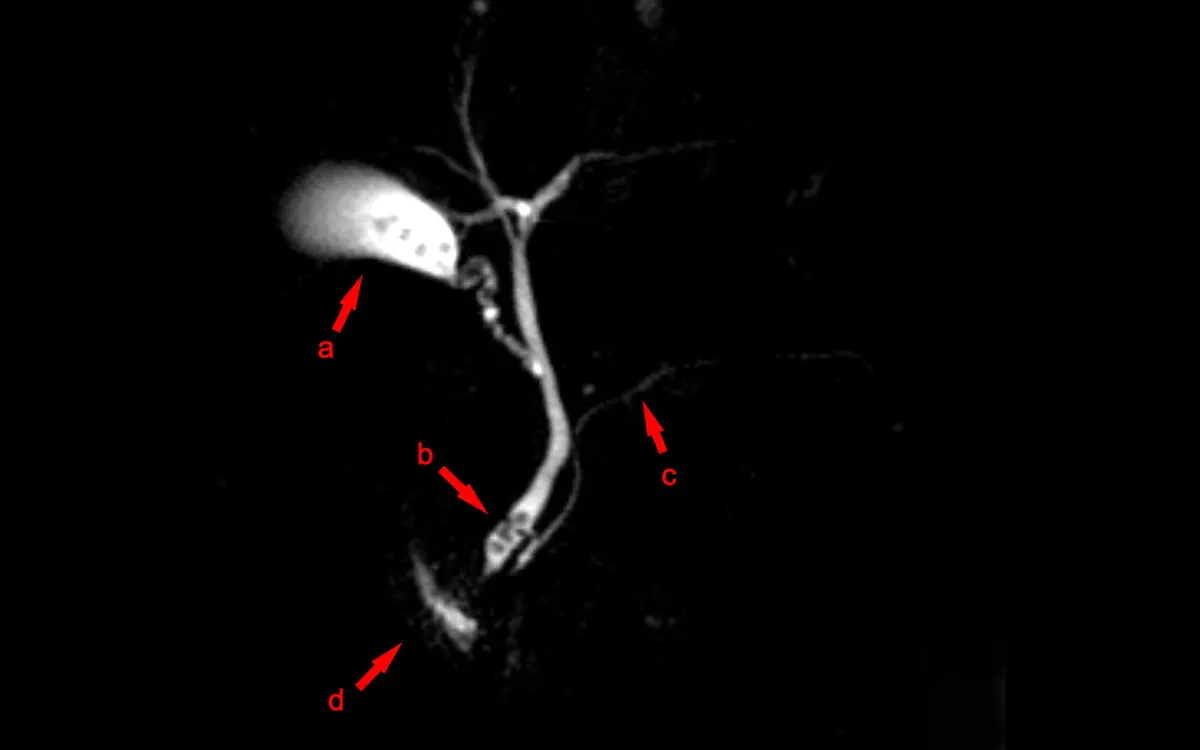
- Bile ducts and pancreas — mapped on the MRCP sequence, a fluid-weighted series needing no contrast, looking for gallstones, duct strictures, and pancreatic cysts, duct dilation, or pancreatitis
- Spleen — checked for size and incidental lesions
- Adrenal glands — nodules characterized with in- and opposed-phase imaging, the chemical-shift technique that separates a benign lipid-rich adenoma from one needing another look
- Kidneys — cysts and solid masses characterized further than a first ultrasound or CT usually allows, and the collecting system checked for dilation
- Bowel and mesentery — wall thickening and mesenteric lymph nodes reviewed, though suspected inflammatory bowel disease is usually better answered by a dedicated MR enterography protocol
- Uterus and ovaries — in women, checked for fibroids, adenomyosis, and an endometrioma or other signs of endometriosis, mapped in soft-tissue detail ultrasound can't always match
- Prostate and seminal vesicles — in men, checked for an enlarged prostate and gland architecture, though a formal cancer risk score needs its own dedicated protocol, described below
- Bladder — wall and contents reviewed
- Bones and soft tissue at the margins — the visible spine and pelvis checked for fractures or marrow signal changes, and the abdominal wall for hernias
Two honest limits are worth stating plainly. MRI doesn't detect kidney stones as reliably as CT or ultrasound, so a stone workup usually stays with those two. And scoring a prostate finding on the PI-RADS scale, or formally staging a rectal or bowel finding, needs its own dedicated protocol, a multiparametric prostate MRI or a high-resolution rectal MRI, not a routine abdomen and pelvic exam ordered for something else. A trustworthy interpretation says so plainly rather than promising more than the protocol allows.
How DocOrbit reads your abdomen and pelvic MRI
Send us the same images, the DICOM files from your scan or a copy of the disc you were given, and a board-certified body radiologist performs a full abdominal and pelvic MRI second read, going through every sequence and organ in turn, and writes a structured report you can hand directly to your own doctor. This is an online MRI second opinion built around images you already have, no new scan needed. The signed report comes back in 24–48 hours, and it isn't a verdict on the first read being wrong, only what a fresh, focused review of your abdominal MRI found, in the clinical language your physician already speaks. If you'd rather not wait to find out, you can have your abdominal MRI re-read by another radiologist starting today.
Get your abdomen and pelvic MRI re-read by a subspecialist
Ask the radiologist questions afterward
One thing that surprises most patients: the second opinion doesn't end when the report lands in your inbox. Once you have it, you can ask a radiologist online about a phrase in the report or what a finding means for you, and get a written answer back. Most people never get the chance to ask the person who actually read their scan anything at all.
Or get an answer in minutes with Orbius
If waiting 24–48 hours isn't what you need right now, DocOrbit also offers Orbius, an AI radiology agent that reads the same MRI and returns a structured report, findings, impression, next steps, in minutes rather than days, at a lower cost, any time of day. Orbius is a fast way to upload your scan for a second opinion when a signed report doesn't fit your timeline, an honest trade of speed against a subspecialist's signature. Upgrading to a full body radiologist read from the same upload is one click away.
How do I send my abdomen and pelvic MRI for a second opinion?
Upload the DICOM files from your scan, or the CD you were given at the imaging center or hospital, directly through the DocOrbit platform. Nothing needs to be mailed or dropped off, the images go straight to the body radiologist reading your case.
Do I need the actual MRI images, or is the written report enough?
You need the images themselves, not just the written report. A genuine second opinion means an online radiologist looks at your abdomen and pelvic MRI directly, sequence by sequence, the same way the first one did, rather than reading someone else's description of what they saw.
Will my own doctor accept a second opinion report?
Yes. The report follows the same structured format radiologists use everywhere, with findings and an impression your doctor can read and act on like any other radiology report, and you're free to share it with them directly.
How long does an abdomen and pelvic MRI second opinion take?
A signed report from a board-certified body radiologist typically comes back in 24 to 48 hours. If you want an answer sooner, Orbius, DocOrbit's AI radiology agent, returns a structured report on the same images in minutes.
Is it worth getting a second opinion if my abdominal MRI was reported as normal?
It can be, especially if your symptoms haven't improved, a lesion was noted without a clear follow-up plan, or the scan was read quickly for one clinical question that wasn't actually yours. A fresh, unhurried review of your abdominal MRI sometimes turns up something the original fast read wasn't looking for, and just as often confirms that normal really does mean normal.
Key takeaways
- An abdomen and pelvic MRI moves through five or more sequences and produces hundreds of images from one appointment, usually read at real speed
- A body radiologist reads abdominal and pelvic imaging almost exclusively, and catches patterns a generalist reading everything is more likely to under-call
- A proper second opinion walks the same anatomy organ by organ, and says plainly when a finding needs a dedicated prostate or rectal MRI protocol instead
- DocOrbit's signed body radiologist read takes 24–48 hours; Orbius, the AI option, returns a structured report in minutes
- You can message the radiologist with questions after the report arrives
Can I get a second opinion on my MRI scan online?
Yes. You upload your images from home, with no CD to mail and no second trip to the imaging center, and a subspecialist body radiologist re-reads the study and writes a structured report you can hand to your own doctor within 24 to 48 hours. You can message the radiologist with questions afterward, and Orbius can return a first read in minutes if you want an answer sooner.
This article is for general information only and is not medical advice. Always discuss your imaging results and any next steps with a qualified physician.