Feeling a lump in your breast, or reading the word "cyst" on an ultrasound or mammogram report, is one of those moments that can hijack a whole day. Here is the reassuring truth most people are searching for first: a simple breast cyst is a harmless, fluid-filled sac, it is not cancer, and it is one of the most common things a breast scan ever finds. This article explains what radiologists actually see, why cysts form, the difference between the types, and the handful of situations that call for a closer look.
What does "breast cyst" mean?
A breast cyst is a small pocket of fluid that forms inside the breast tissue, a bit like a tiny water balloon. It develops when one of the breast's milk-producing glands (a lobule) fills with fluid instead of staying flat and empty. Cysts can be too small to feel, or large enough to form a smooth, movable lump you notice in the shower.
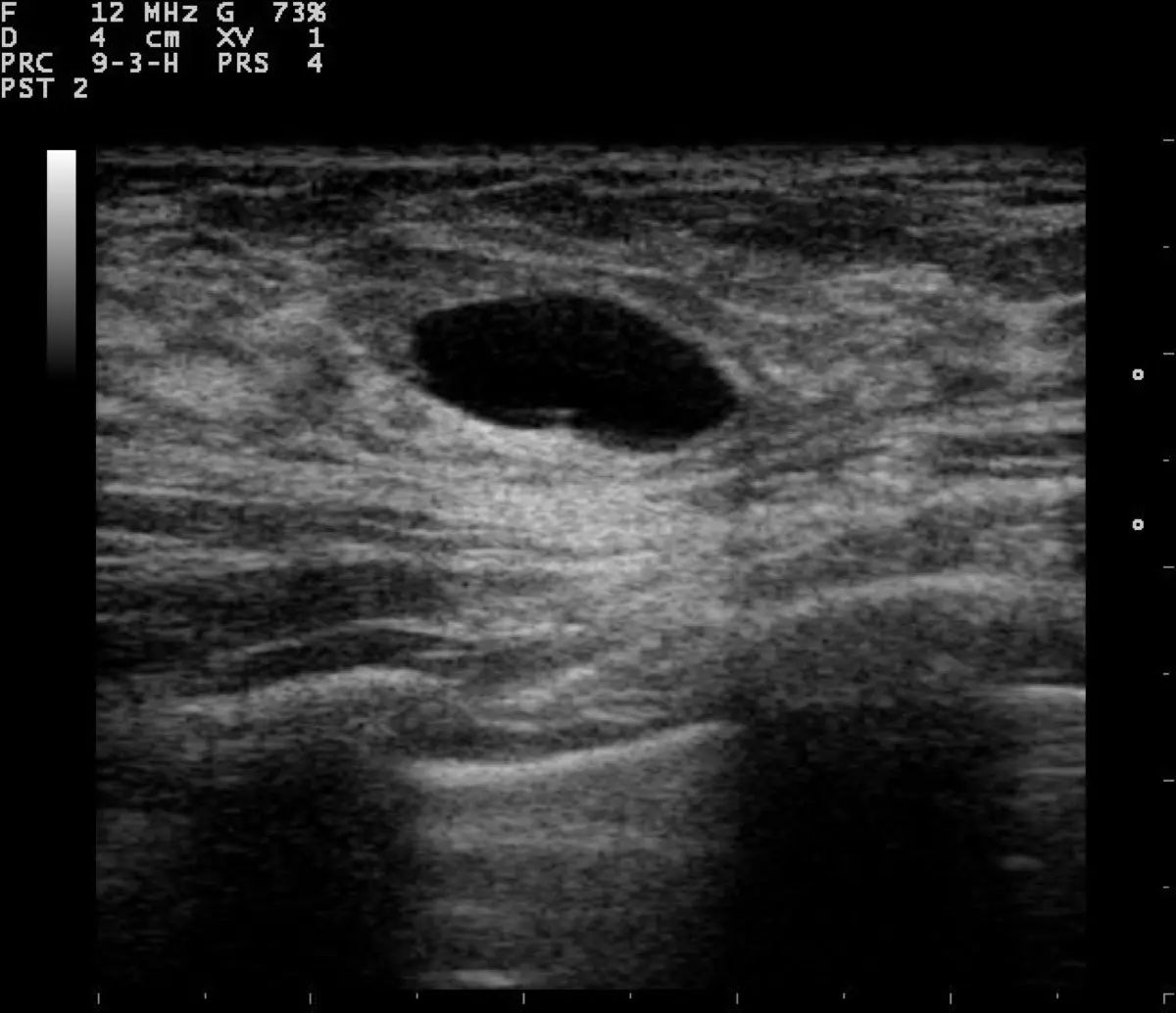
Ultrasound is the single best test for a cyst, because sound waves pass cleanly through fluid. On the screen a classic simple cyst has a very recognizable look that radiologists trust:
- Round or oval, with a thin, sharply defined wall
- Completely black inside (anechoic), because there is nothing solid to bounce the sound back
- A bright "enhancement" stripe behind it, where the sound passed through the fluid easily
- No solid lumps, thick walls, or blood flow inside it
When all of those boxes are ticked, the finding is about as reassuring as breast imaging gets. On a mammogram a cyst usually looks like a round, well-defined mass that is impossible to tell apart from a solid lump on the X-ray alone, which is exactly why an ultrasound is so often added: it instantly settles whether the lump is fluid or solid. Radiologists summarize their level of concern with a standardized BI-RADS category, and a simple cyst is typically labeled BI-RADS 2 (benign).
Simple, complicated, and complex cysts
Not every cyst reads as perfectly clear, and the wording on your report matters. Radiologists sort breast cysts into three groups, and the names sound more alarming than they usually are:
- Simple cyst: pure fluid, thin wall, completely benign. No follow-up needed beyond your routine schedule.
- Complicated cyst: fluid with a few faint internal echoes, often just thick fluid or debris. The large majority are still benign, and they are usually either watched briefly or aspirated if there is any doubt.
- Complex cyst (complex cystic and solid mass): has genuine solid parts, a thick wall, or internal divisions. This is the one category that needs closer evaluation, because a small fraction can harbor something that is not benign.
The key point: "complicated" and "complex" are not the same word, and they are not the same level of concern. A complicated cyst is a reassuring cousin of the simple cyst. A complex cyst is the one your doctor will want to characterize further.
Common causes
Breast cysts are overwhelmingly a hormonal phenomenon. The breast tissue responds to the monthly rise and fall of estrogen and progesterone, and in some women that cycle leaves glands filled with fluid. This explains the pattern doctors see again and again:
- They are most common in women in their 30s, 40s, and the years approaching menopause
- They often swell and become tender in the days before a period, then ease afterward
- They frequently shrink or disappear after menopause, unless a woman is taking hormone therapy
Importantly, cysts are not caused by anything you ate or did. The long-repeated idea that caffeine causes breast cysts has not held up in good studies, though some women do notice less tenderness when they cut back. They are simply a normal-tissue response to your body's own hormones.
Is it serious?
In the overwhelming majority of cases, a breast cyst is not serious at all. Simple and complicated cysts are benign, and having them does not raise your future breast cancer risk. The reason breast imaging takes any lump seriously is not the cyst itself, but the small number of look-alikes: a complex cystic-and-solid mass, or a solid lump that only seemed cyst-like until ultrasound looked closely. That is why characterization matters more than the word "cyst" on its own.
Features that prompt a closer look rather than simple reassurance include a thick or irregular wall, solid tissue or blood flow inside the cyst, rapid growth, or a cyst that appears alongside skin changes or nipple discharge. None of this means cancer. It means the finding earns a proper workup instead of being waved through, which is exactly how careful breast care is supposed to work.
Symptoms
Plenty of breast cysts cause no symptoms at all and are found by chance on a scan done for another reason. When a cyst is large enough to feel, it usually has a characteristic personality: a smooth, round, movable lump that can feel firm or even slightly squishy, and that often becomes more tender and noticeable just before a period. Some women feel a dull ache or pressure if a cyst grows quickly. A lump that is hard, fixed in place, or paired with skin dimpling, nipple retraction, or bloody discharge is a different picture and deserves prompt evaluation, the same way any new and unusual breast change does.
How is it diagnosed and followed up?
Diagnosis combines a clinical breast exam with imaging. Ultrasound does most of the work, because it tells fluid from solid in seconds; mammography adds context, especially in women over 40. When the ultrasound shows a textbook simple cyst, the workup is essentially complete, and you simply continue with your normal screening schedule. There is no need for repeated scans of a clearly simple cyst.
When there is genuine uncertainty, such as a complicated cyst that is large or symptomatic, the next step is often a fine-needle aspiration: a thin needle draws out the fluid, which both relieves the lump and confirms it was fluid all along. For a complex cyst with solid parts, a core-needle biopsy samples the solid tissue so a pathologist can confirm what it is. This image-then-characterize approach is the same careful logic used for other common findings women encounter, such as a fibroadenoma on breast ultrasound or an ovarian cyst on ultrasound.
Treatment options
The honest answer is that most breast cysts need no treatment at all. The realistic options are:
- Reassurance and routine follow-up: the default for a simple cyst. Many resolve on their own, and there is nothing to remove.
- Aspiration: draining the fluid with a fine needle, offered when a cyst is large, painful, or keeps coming back. It is quick and done in the clinic.
- Further sampling or, rarely, removal: reserved for complex cysts with solid components, or cysts that refill repeatedly and stay symptomatic.
There is no pill that dissolves a cyst, and treating one does not stop new ones from forming elsewhere, because the underlying driver is your normal hormonal cycle. For tenderness, many women find that a well-fitting supportive bra, over-the-counter pain relief, and warm compresses are enough.
Why a second read can help
Breast imaging is one of the areas where a careful, expert read matters most, because so much rests on a single distinction: simple versus complex, watch versus sample. That call decides whether you go home reassured or move on to a biopsy. If you want added confidence in how your ultrasound or mammogram was interpreted, DocOrbit offers an expert second read of your images that you can share directly with your own doctor. It is a calm way to ask "is this really a simple cyst, and did anyone miss anything?" before you decide on next steps. The same reasoning applies to getting a second radiological opinion for any finding that worries you.
Is a breast cyst cancer?
A simple breast cyst is not cancer. It is a fluid-filled sac, and on ultrasound radiologists can see straight through it, which is one of the most reliable signs of a benign finding. Cancers are solid, not fluid-filled. A radiologist still distinguishes a simple cyst from a complicated or complex one, but the ordinary breast cyst that most women have is benign.
Do breast cysts go away on their own?
Many do. Breast cysts are driven by hormones, so they often grow and shrink with the menstrual cycle and frequently disappear after menopause. Some come and go over months, others stay stable for years. Because the pattern varies, a newly found cyst with classic features usually just needs reassurance rather than treatment.
Do breast cysts need to be drained?
Most do not. A simple cyst that is not causing symptoms is usually left alone. Drainage with a fine needle (aspiration) is offered mainly when a cyst is large and painful, or when the radiologist wants to confirm the contents of a cyst that does not look perfectly simple. Draining a comfortable cyst for no clinical reason is generally unnecessary.
Can a breast cyst turn into cancer?
A simple breast cyst does not turn into cancer, and having simple cysts does not meaningfully raise your breast cancer risk. The small exception is a complex cyst, which has solid components inside it. Those are not cysts turning cancerous, but findings that need closer evaluation, sometimes with a biopsy, to be sure of what they are.
Why do breast cysts form?
Breast cysts form when the small milk glands (lobules) in the breast fill with fluid, usually as part of normal, hormone-driven changes in the breast tissue. They are most common in women in their 30s, 40s, and early 50s, and tend to settle after menopause. They are not caused by diet, caffeine, or anything you did wrong.
Key takeaways
- A simple breast cyst is a harmless, fluid-filled sac. It is not cancer.
- Ultrasound is the best test: a simple cyst looks round, thin-walled, and completely black inside.
- "Complicated" cysts are still almost always benign; only "complex" cysts with solid parts need a closer look.
- Cysts are hormone-driven, so they swell with the cycle and often settle after menopause.
- Most need no treatment; aspiration is for large or painful cysts, biopsy for complex ones.
Still unsure what the rest of your report says? Paste it into our free radiology report explainer and read it back in plain English, with each medical term defined and a short list of questions worth asking your doctor.
How do I have my ultrasound reviewed by another radiologist online?
Yes. Online radiology second opinions run entirely from home: you upload your images, with no CD to post and no second trip, and a subspecialist radiologist re-reads the study and writes a structured report you can give to your own doctor. DocOrbit returns that signed second read in 24 to 48 hours. You can then message the radiologist with questions about the ultrasound and about what the report actually means for you.
This article is for general information only and is not medical advice. Always discuss your imaging results and any next steps with a qualified physician.