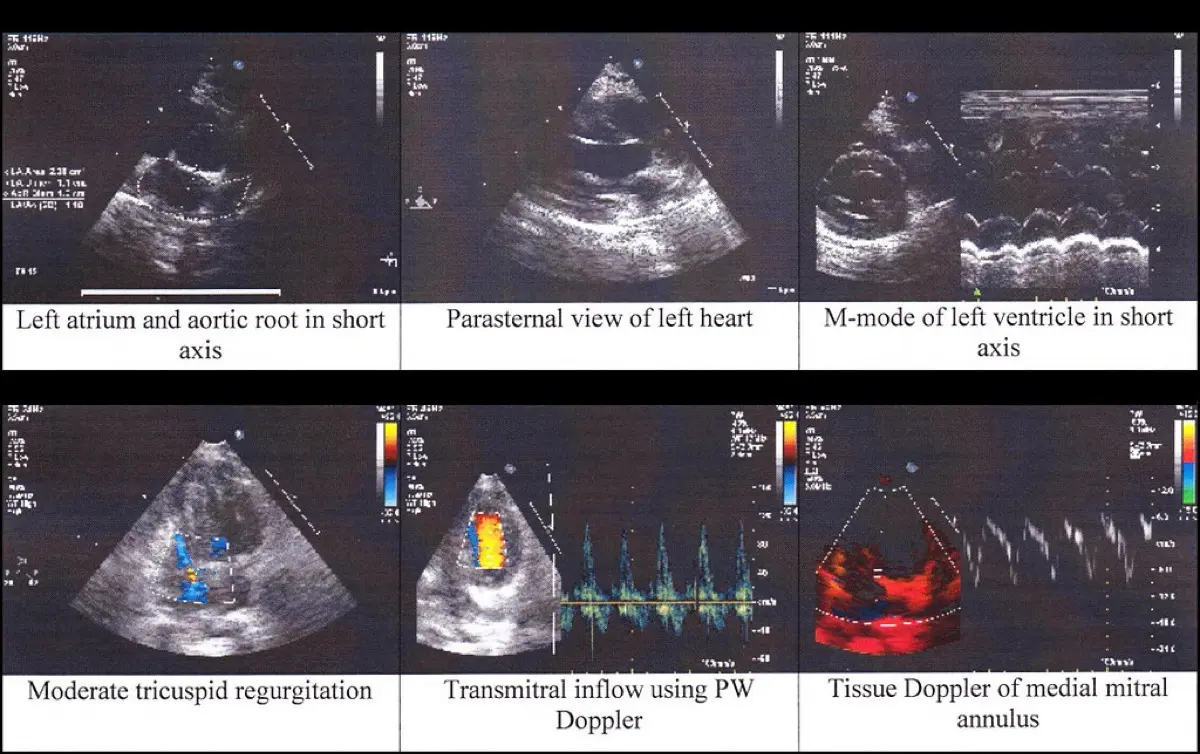
If your vet's echocardiogram report mentions "hypertrophic cardiomyopathy", "HCM", or simply a "thickened left ventricular wall", it is completely natural to feel shaken. The reassuring truth is that HCM is the most common heart condition in cats, that many cats with it stay comfortable for years, and that a diagnosis is the start of a plan rather than a verdict. This article explains what the finding means, what those wall-thickness numbers are really saying, the warning signs worth knowing, and how the condition is monitored and managed.
What is hypertrophic cardiomyopathy in cats?
Hypertrophic cardiomyopathy is a disease in which the muscular wall of the heart's main pumping chamber, the left ventricle, becomes abnormally thick. A thickened wall makes the chamber stiffer, so it does not relax and fill with blood as easily between beats. Over time that can raise pressure behind the heart and enlarge the left atrium, the chamber just upstream.
Echocardiography, which is simply an ultrasound of the heart, is the key test because it lets a veterinarian actually see and measure the heart muscle while it beats. Other tests play supporting roles, but only the echo shows the thickened wall directly, while look-alike causes such as high blood pressure or an overactive thyroid gland — both of which can thicken the heart for entirely different reasons — are excluded with a blood-pressure measurement and a thyroid test.
- The left ventricle wall becomes thicker than normal
- The stiff chamber fills less easily, so pressure can build upstream
- The left atrium may enlarge as a result
- Other causes of thickening, such as thyroid disease or high blood pressure, are ruled out first
What the echocardiogram measurements mean
Echo reports are full of numbers, and the one owners fixate on is the wall thickness of the left ventricle in diastole, when the heart is relaxed and full. A common rule of thumb is that a wall measuring more than about 6 mm raises suspicion for HCM, but this is only a rough threshold, not a diagnosis on its own. Measurements sit on a spectrum, they can be affected by how the cat was positioned and how fast the heart was beating, and a mildly high number in a stressed cat may look very different on a calmer day.
This is exactly why the numbers need a cardiologist to interpret them. A specialist looks at the whole picture: which parts of the wall are thickened, the size of the left atrium (often a better guide to how much the disease matters), the pattern of blood flow, and whether the heart is coping. A slightly thick wall with a normal-sized atrium and no symptoms is a very different situation from a markedly thick wall with a large atrium. Treat any single millimetre figure with caution and let it be judged in context.
Why HCM is often silent — and the warning signs
One of the hardest things about HCM is that many affected cats seem perfectly well. They eat, play, and behave normally, and the condition is often first suspected only when a vet hears a heart murmur, an extra "gallop" sound, or an irregular rhythm during a routine check. Some cats are picked up on pre-anaesthetic screening or breed testing before any sign appears at all.
The condition tends to announce itself in one of two ways when it does progress, and both deserve to be recognised calmly but promptly. The first is congestive heart failure, where fluid backs up into or around the lungs. The clearest sign at home is fast or laboured breathing while your cat is resting or asleep, sometimes with open-mouth breathing. Breathing trouble at rest is itself an emergency and needs a vet the same day. The second, and the most dramatic emergency, is arterial thromboembolism, often called a "saddle thrombus": a blood clot lodges where the main artery to the back legs divides, causing sudden, painful weakness or paralysis of one or both hind limbs, often with cold paws and crying out. This needs a veterinarian immediately. Knowing these signs is not about living in fear; it is about acting quickly on the rare day it counts, much as owners learn the red flags for a splenic mass found on abdominal ultrasound in dogs.
How HCM is diagnosed and monitored
The echocardiogram is the centrepiece, but a few other tests round out the picture. A blood test called NT-proBNP can act as a screening flag: a raised level suggests the heart is under strain and that an echo is worth doing, though it cannot diagnose HCM by itself. Chest X-rays are good at showing heart failure, meaning fluid in or around the lungs, but they cannot see the muscle thickening that defines the disease. Blood pressure measurement and a thyroid test help exclude the mimics mentioned earlier.
Once HCM is confirmed, monitoring is usually about repeating the echo periodically to watch the wall thickness, the atrial size, and any change in how the heart fills. Your vet may also teach you to count your cat's resting breathing rate at home, which is one of the simplest and most useful early warnings of fluid building up. How often a cat is rechecked depends on how advanced the disease is and is decided case by case.
Which cats are at higher risk
HCM can affect any cat, including ordinary domestic shorthairs and longhairs, but some pedigree breeds are recognised as predisposed. Maine Coons and Ragdolls are the classic examples, and importantly each has a specific genetic test for a known mutation, so breeders and owners can screen for it. Other breeds, including the British Shorthair, Sphynx, and Persian, are also reported more often. Males tend to be affected somewhat more than females, and the disease is frequently picked up in middle age, though it can appear earlier or later. A positive gene test does not guarantee a cat will develop clinically important disease, and a negative test does not entirely remove the possibility, which is another reason the echo remains the reference test.
How HCM is managed
It is honest to say up front that treatment manages HCM rather than cures it; nothing currently reverses the thickened muscle. The goal is to keep your cat comfortable, reduce the workload on the heart, and lower the risk of the two complications above. What that looks like depends entirely on the stage of disease.
- Cats with mild, symptom-free HCM often need no medication at all, just periodic monitoring
- If the left atrium is enlarged and clot risk is a concern, a blood-thinning medication is commonly used
- If congestive heart failure develops, diuretics and other heart medications are used to clear and control fluid
- Reducing stress, avoiding unnecessary anaesthesia, and managing any thyroid or blood-pressure problems all help
Because the plan is so individual, it is set and adjusted by your vet or a cardiologist as your cat's heart is followed over time. Two cats with the same headline diagnosis can be managed quite differently, just as the approach to hip dysplasia seen on an X-ray in dogs depends far more on how the animal is coping than on the images alone.
Why a second read can help
An echocardiogram is one of the most operator-dependent imaging tests there is, and the diagnosis often hinges on a few millimetres of measurement and on how the left atrium is judged. If the report leaves you uncertain, or if a big decision hangs on borderline numbers, having another expert look at the images and measurements can bring real peace of mind. DocOrbit offers a veterinary second opinion on your pet's imaging that you can share with your own vet, which is especially reassuring when a finding sits in the grey zone between mild and significant. It is not a replacement for your treating vet, but an extra set of specialist eyes on the same pictures.
Is hypertrophic cardiomyopathy in cats always fatal?
No. Many cats with HCM have a mild form, stay comfortable for years, and die of something unrelated. The outlook is much more variable than most owners fear and depends heavily on how thick the muscle is, how large the left atrium has become, and whether complications have appeared. Because the range is so wide, a cardiologist's assessment of your own cat's echocardiogram matters far more than the diagnosis label alone.
What is the life expectancy of a cat with HCM?
It varies enormously. Cats with mild, stable disease and no symptoms often live for many years, while cats that have already had heart failure or a clot tend to have a more guarded outlook. There is no single number that fits every cat, so a cardiologist estimates the range for your individual cat based on the echocardiogram findings and how the heart behaves over time.
Can HCM in cats be cured?
There is no cure that reverses the thickened heart muscle, and treatment aims to manage the disease rather than undo it. Medications can ease the workload on the heart, control heart failure if it develops, and lower the risk of dangerous clots. Regular monitoring with a veterinarian lets the plan be adjusted as the heart changes.
What are the signs of heart failure in a cat with HCM?
The most important sign is fast or laboured breathing at rest, which you can check by counting the breaths while your cat is asleep and calm. Open-mouth breathing, unusual lethargy, hiding, or a sudden loss of appetite can also signal trouble. Any of these, and especially sudden painful weakness or paralysis of the back legs, is an emergency that needs a veterinarian straight away.
Which cat breeds are most at risk for HCM?
Maine Coons and Ragdolls are the best-known predisposed breeds, and each has a specific genetic test for a known mutation. Other breeds such as the British Shorthair, Sphynx, and Persian are also reported to be affected more often. HCM is common in ordinary domestic cats too, so any cat with a murmur or an abnormal heartbeat may be checked regardless of breed.
Key takeaways
- HCM is the most common heart disease in cats, and many affected cats stay comfortable for years
- Echocardiography is the key test; a wall over roughly 6 mm is a rough flag, not a diagnosis, and needs a cardiologist to interpret
- The disease is often silent until a murmur is heard or a crisis occurs
- Fast breathing at rest, or sudden painful weakness of the back legs, is an emergency
- Treatment manages rather than cures HCM, and the plan is tailored to each cat over time
This article is for general information only and is not veterinary advice. Always discuss your animal's imaging results and next steps with a qualified veterinarian.