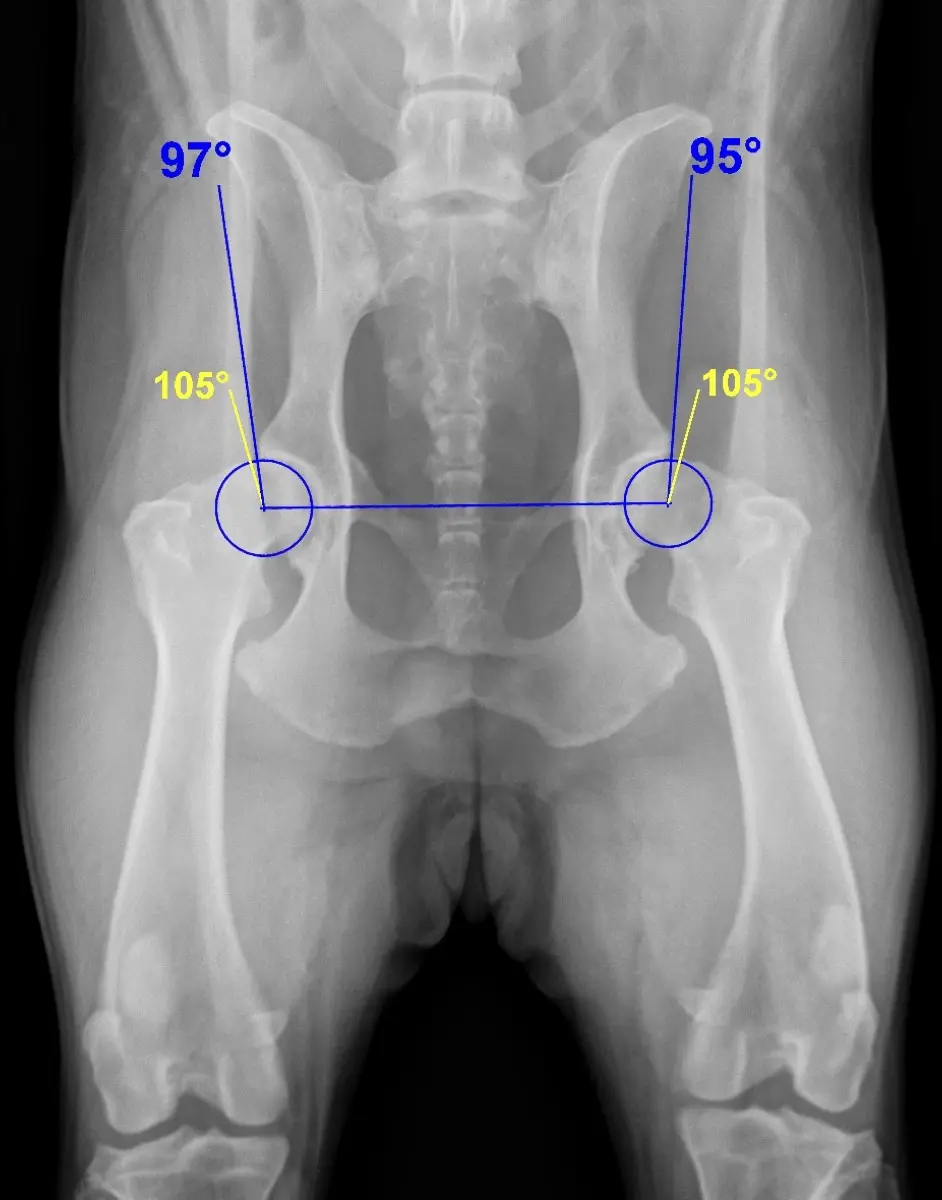
If your dog's pelvic X-ray report mentions "hip dysplasia", "coxofemoral subluxation", or the abbreviation "CHD", it is natural to feel a jolt of worry, especially for a young dog with a long life ahead. The reassuring truth is that most dogs with hip dysplasia go on to live full, active lives, and the large majority are managed comfortably without ever needing surgery. Here is what the term actually means on a radiograph, how hips are graded, the signs to watch for, and the wide range of ways your vet can help.
What "hip dysplasia" means on a radiograph
A healthy hip is a ball-and-socket joint: the round head of the thigh bone (the femoral head) sits snugly inside a cup in the pelvis (the acetabulum). In hip dysplasia the fit is loose or shallow, so the ball rides partly out of the socket. Radiologists call that partial dislocation "subluxation", and "coxofemoral" simply means the hip joint. CHD stands for canine hip dysplasia.
On the X-ray, a vet looks at how deeply the femoral head sits in the socket and whether the joint has already started to change shape. Over time, a loose joint grinds and remodels, which is why reports often mention secondary signs.
- A shallow socket that covers too little of the femoral head
- A visible gap or step where the ball has shifted out of the cup
- Extra bone (osteophytes) forming around the joint margins
- Flattening or a mushroom shape of the femoral head from wear
Importantly, an X-ray is a single snapshot of the bones. It cannot feel how loose the joint is when your dog moves, and it cannot measure pain. That is why the grade always has to be read alongside your dog's examination, age, and behavior.
Which dogs are most at risk
Hip dysplasia is far more common in large and giant breeds, and certain names come up again and again: German Shepherds, Labrador Retrievers, Golden Retrievers, Rottweilers, and many mastiff-type dogs. That said, almost any breed can be affected, and even smaller and mixed-breed dogs occasionally are. Genetics is the strongest single factor, which is why responsible breeders screen the parents' hips before breeding.
Growth matters too. Puppies that gain weight very quickly or are pushed into hard, repetitive exercise while their joints are still forming may be more likely to develop looser hips. This explains why keeping a growing large-breed puppy lean and steady is so often recommended.
How hips are scored: OFA, PennHIP, and FCI
Because "how bad is it?" is the first thing every owner asks, several formal scoring systems exist to bring consistency to hip X-rays. They are not interchangeable, and each has its own rules for how the dog must be positioned.
- OFA (Orthopedic Foundation for Animals) — widely used in North America. A specialist assigns a grade running from excellent, good, and fair (normal), through borderline, to mild, moderate, and severe dysplasia.
- PennHIP — uses specially stressed X-rays to calculate a "distraction index", a number that reflects how loose the joint is. Looser joints carry a higher lifetime risk of arthritis.
- FCI (Fédération Cynologique Internationale) — the common European scheme, grading hips from A (normal) through B, C, and D to E (severe).
All of these depend on precisely positioned radiographs, usually with the dog relaxed under sedation, and they are interpreted by trained assessors. A poorly positioned film can make hips look better or worse than they are, which is one reason a careful second look at the images is worthwhile before any big decision. Because dysplasia often travels with other orthopedic issues, your vet may also keep an eye out for problems such as a cranial cruciate ligament tear that can affect the same hind limbs.
Signs owners actually notice
Many dogs with mild dysplasia show nothing at all for years. When signs do appear, they tend to be subtle at first and easy to put down to age or laziness.
- A "bunny-hopping" run, where both back legs push off together
- Stiffness after rest or after sleeping, which loosens up once they get going
- Trouble rising, hesitating before jumping, or slowing down on stairs
- Less enthusiasm for long walks or play than before
- A narrow stance behind, or a wobble or sway in the hindquarters
These signs overlap with several other conditions, including back problems such as intervertebral disc disease, so they are a reason to see your vet rather than a diagnosis in themselves. Dogs are also good at hiding discomfort, so a hands-on exam often reveals more than watching them at home.
Why the grade must match the dog
This is the single most important point for any worried owner: the X-ray grade and your dog's comfort do not always line up. Some dogs with strikingly abnormal hips trot around happily for years, while others with milder changes are noticeably sore, mostly because of the secondary arthritis that builds up. A number on a report is not a prognosis. Your vet weighs the images against how your dog walks, rises, and responds to gentle manipulation of the joint.
Managing hip dysplasia without surgery
For most dogs, the mainstay of treatment is not an operation. A thoughtful, non-surgical plan keeps the large majority comfortable and active, and it is usually where your vet will start.
- Weight control — keeping your dog lean is the single most effective thing you can do. Every extra kilogram loads the hips and speeds up arthritis.
- Controlled, regular exercise — steady low-impact activity such as lead walks and swimming builds the muscle that supports the joint, while avoiding weekend-warrior bursts.
- Physiotherapy and hydrotherapy — underwater treadmills and targeted exercises maintain range of motion and strength with minimal joint stress.
- Joint supplements — omega-3 fatty acids and products such as glucosamine and chondroitin are commonly used to support joint comfort.
- Anti-inflammatory medication — veterinary NSAIDs and other pain relievers, used strictly under a vet's guidance, control flare-ups. Never give human painkillers, which can be toxic to dogs.
Many dogs stay on a version of this plan for life, with the details adjusted as they age.
When surgery is considered
Surgery comes into the picture when pain cannot be controlled by conservative care, or in specific young dogs where an early procedure can steer the hip toward a better shape. The right choice depends on the dog's age, size, and the state of the joint, and it is a decision for you and a surgeon together.
- FHO (femoral head ostectomy) — removes the ball of the joint so a cushion of scar tissue forms a "false joint". Often a good option for smaller and lighter dogs.
- Total hip replacement — replaces the whole joint with an implant, and can restore excellent function in larger dogs with severe disease.
- JPS and DPO/TPO — juvenile pubic symphysiodesis and double or triple pelvic osteotomy are procedures done in carefully selected young dogs to improve how the hip develops before arthritis sets in.
Why a second read can help
Hip scores hinge on precise positioning and experienced interpretation, and the same set of films can look different in different hands. Before committing to surgery or an expensive workup, many owners find it reassuring to have another specialist look at the radiographs. DocOrbit offers a veterinary second opinion on your animal's imaging that you can share with your own vet, so the grade and the plan rest on more than one expert's read. It is about making a big decision with as much clarity as possible.
Does hip dysplasia on an X-ray always mean my dog needs surgery?
No. The large majority of dogs with hip dysplasia are managed successfully without surgery, using weight control, controlled exercise, physiotherapy, joint supplements, and anti-inflammatory medication when a vet prescribes it. Surgery is considered mainly when pain cannot be controlled by these measures, or in specific young dogs where an early procedure can improve the hip's development. What the X-ray shows matters far less than how your dog actually moves and feels.
What are the first signs of hip dysplasia in dogs?
Owners often notice a bunny-hopping gait where both back legs move together, stiffness after rest that eases with movement, reluctance to jump or climb stairs, and difficulty rising. Some dogs simply seem less keen on long walks or play. These signs can come and go, and they overlap with other joint problems, so they need to be checked by a vet rather than assumed to be dysplasia.
Which dog breeds are most at risk of hip dysplasia?
Hip dysplasia is most common in large and giant breeds, including German Shepherds, Labrador Retrievers, Golden Retrievers, Rottweilers, and many mastiff-type dogs. It can occur in almost any breed, and even small dogs and mixed breeds are occasionally affected. Both genetics and early growth factors such as rapid weight gain and over-exercise of puppies play a role.
How is hip dysplasia scored on X-rays?
Several systems exist. In North America the OFA assigns a grade from excellent to severely dysplastic, while PennHIP measures a distraction index that reflects how loose the joint is. In much of Europe the FCI uses an A-to-E scale, where A is normal and E is severe. These schemes require carefully positioned X-rays and are read by trained specialists, which is one reason a second opinion on the images can be valuable.
Can a dog with hip dysplasia live a normal life?
Yes, many do. With a healthy body weight, sensible exercise, and treatment of pain when it appears, a large number of dysplastic dogs stay active and comfortable for years. The condition is usually managed rather than cured, so the aim is a good quality of life rather than a perfect X-ray. Your vet will tailor the plan to your dog's age, size, and how the joints behave over time.
Is hip dysplasia painful for dogs?
It can be, but not always, and the amount of pain does not reliably match the severity seen on the X-ray. Some dogs with dramatic-looking hips cope remarkably well, while others with milder changes are more uncomfortable, largely because of the secondary arthritis that develops. Because pain can be subtle in dogs, a vet's hands-on examination is the best way to judge how much the hips are actually bothering your dog.
Key takeaways
- Hip dysplasia means a loose or shallow hip joint; it is common in large breeds and often manageable
- The X-ray grade must be matched to your dog's exam and comfort, not read in isolation
- OFA, PennHIP, and FCI are the main scoring systems, and they need precise positioning
- Most dogs do well without surgery, through weight control, exercise, physiotherapy, and pain relief
- Surgical options exist when needed, and a second read of the images can guide a big decision
This article is for general information only and is not veterinary advice. Always discuss your animal's imaging results and next steps with a qualified veterinarian.