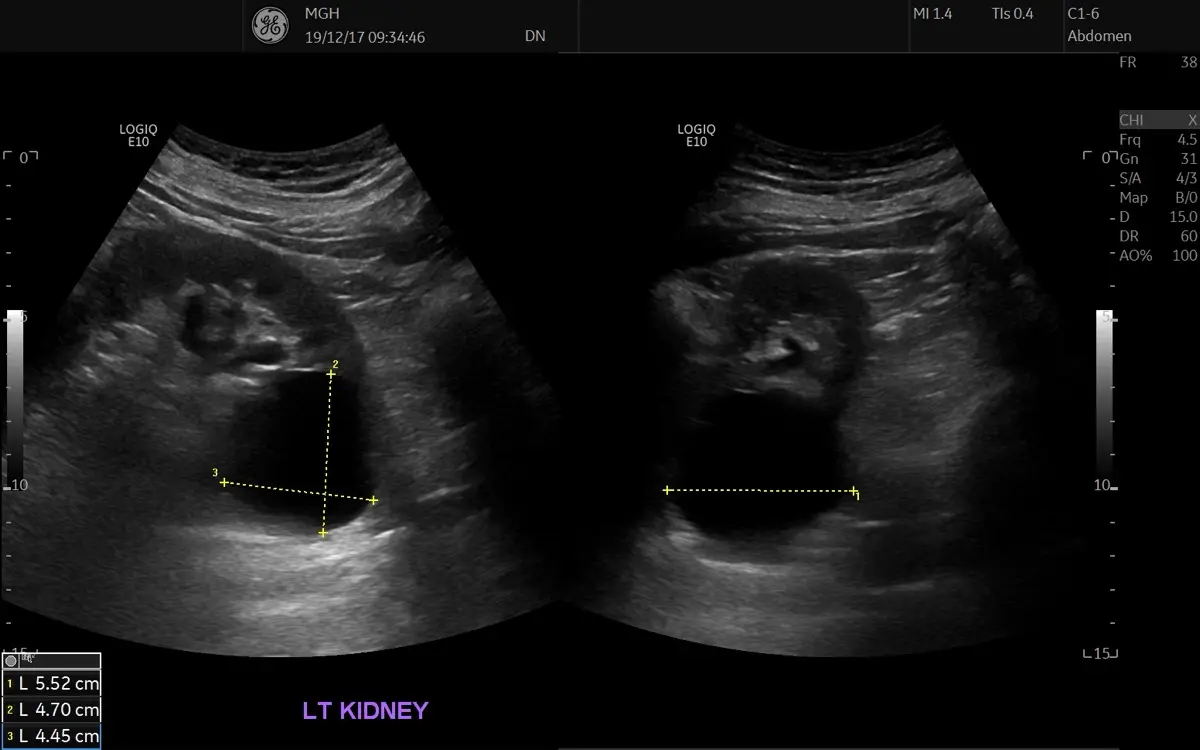
Seeing the words "renal cyst" or "cyst on the kidney" on an ultrasound or CT report can send your mind straight to the worst place. Here is the reassuring truth before anything else: the overwhelming majority of kidney cysts are simple cysts, harmless, fluid-filled sacs that are not cancer, do not spread, and very often need no treatment at all. They are one of the most common things radiologists find, and the chance of having one rises steadily with age. This article explains what a renal cyst actually is, why they form, how doctors tell the harmless ones from the few that need a closer look, and what follow-up usually involves.
What does "renal cyst" mean?
A renal cyst is a small, round pouch of fluid that forms in or on the kidney. Think of it like a tiny water balloon sitting in the kidney tissue. Most are "simple" cysts, meaning they are filled with clear, watery fluid, have a thin smooth wall, and nothing solid inside.
On imaging, a simple cyst has a very recognisable, reassuring look:
- On ultrasound, it appears as a perfectly black (anechoic), round area with a sharp edge and brightness behind it, a textbook pattern radiologists see countless times a week.
- On CT, it shows up as a smooth, low-density (fluid) area that does not light up when contrast dye is given.
- On MRI, it follows the signal of plain fluid, very bright on certain sequences, dark on others.
When all of these "simple" boxes are ticked, radiologists are highly confident the finding is benign. The picture is so consistent that a clearly simple cyst usually needs no further imaging at all.
What causes kidney cysts?
For most people, simple renal cysts are just a normal part of getting older. Tiny pouches develop in the kidney's drainage tubules, fill with fluid, and gradually become visible on scans. They are not caused by anything you ate, drank, or did.
- Age, the single biggest factor. Simple cysts are uncommon in young adults and very common past middle age.
- Plumbing changes in the kidney, small blockages in the tiny tubules that filter urine can let fluid pool into a pouch.
- Inherited conditions, far less commonly, many cysts in both kidneys can be part of polycystic kidney disease, an inherited condition that is quite different from an ordinary single simple cyst.
The distinction matters: one or two simple cysts on an aging kidney is an everyday, expected finding. Dozens of cysts in a younger person with a family history is a separate story that a doctor will look into specifically.
Is a renal cyst serious?
Is a renal cyst serious? Most renal cysts are simple cysts, which are benign fluid-filled sacs that are not cancer and rarely cause problems. They are extremely common and become more frequent with age. A cyst becomes more meaningful only when it has complex features on imaging, grows over time, or causes symptoms, and even then, many turn out to be harmless.
To keep this objective and consistent, radiologists grade kidney cysts with the Bosniak classification system. In plain terms:
- Bosniak I, a straightforward simple cyst. Benign, no follow-up needed.
- Bosniak II, a few minor features (like a thin calcification) but still considered benign.
- Bosniak IIF, slightly more complex; usually watched with a follow-up scan to confirm it stays stable.
- Bosniak III and IV, complex cysts with thicker walls, internal divisions, or solid components. These carry a real chance of being or becoming a tumour and are typically evaluated by a urologist.
The key point: the large majority of cysts that turn up on a routine scan are category I or II, the harmless end of the scale.
What symptoms do kidney cysts cause?
Usually none. Most simple cysts are silent and are only discovered by chance when you have a scan for an unrelated reason, back pain, an abdominal ultrasound, a CT for kidney stones. That is exactly why they so often arrive as a surprise on a report.
When a cyst does cause symptoms, it is generally because it has grown large enough to press on something or has become complicated. Possible signs include:
- A dull ache in the side, back, or upper abdomen
- Blood in the urine
- Fever and pain if a cyst becomes infected
- Occasionally, a feeling of fullness on one side
These symptoms are not specific to cysts and overlap with far more common issues like kidney stones, so they always need to be interpreted alongside your history and exam rather than from the scan alone.
How are renal cysts followed up?
For a clearly simple (Bosniak I) cyst, the answer is usually the most welcome one in medicine: nothing. No repeat scans, no specialist, no treatment, it is noted and you carry on.
For cysts that look slightly more complex, doctors take a measured "watch and confirm" approach. A follow-up ultrasound, CT, or MRI a few months to a year later checks whether the cyst is staying stable. Stability over time is itself strongly reassuring. If a cyst has more complex features, a dedicated kidney CT or MRI with contrast gives the clearest picture, and a urologist may be involved to decide next steps. Follow-up recommendations vary by patient and depend on the exact imaging features, your age, and your overall health.
How are kidney cysts treated?
The honest answer for most people is: they aren't, because they don't need to be. Simple cysts are left alone. Treatment only enters the conversation when a cyst is causing a real problem, such as:
- Pain from a large cyst pressing on surrounding tissue
- Infection inside a cyst, which is treated with antibiotics and sometimes drainage
- Obstruction, where a cyst blocks the normal flow of urine
- Complex features that raise concern for a tumour, where surgery may be recommended
When intervention is needed, options range from draining the cyst with a needle (sometimes injecting a solution to stop it refilling) to minimally invasive surgery. These are the exception, not the rule.
Are there lifestyle changes that help?
There is no diet, supplement, or exercise proven to shrink or prevent ordinary simple cysts, and importantly, nothing you did caused them. The most useful habits are the same ones that keep your kidneys healthy in general: stay well hydrated, keep blood pressure under control, and avoid smoking. If you have many cysts or a family history of polycystic kidney disease, your doctor may monitor your blood pressure and kidney function more closely, since that situation is managed differently from a single simple cyst.
Why a second read can help
Most of the worry around a renal cyst comes from one word on a report and not enough plain-language context around it. The features that separate a harmless simple cyst from a complex one are subtle, and how confidently a cyst is classified can genuinely affect whether you need follow-up. A clear, expert second read can confirm the Bosniak category, flag anything that warrants a closer look, and give you a plain-English summary you can bring to your own doctor. DocOrbit offers exactly that kind of independent second opinion on your imaging, useful peace of mind when a report leaves you with more questions than answers. If your cyst is described as complex or you also have other abdominal findings, it can be reassuring to read it alongside our explainer on benign liver lesions like hemangiomas.
Is a renal cyst serious?
Most renal cysts are simple cysts, which are benign fluid-filled sacs that are not cancer and rarely cause problems. They are extremely common and become more frequent with age. A cyst becomes more meaningful only when it has complex features on imaging, grows over time, or causes symptoms, and even then, many turn out to be harmless.
Can a renal cyst turn into cancer?
A simple renal cyst essentially never turns into cancer. The concern is with complex cysts that have thick walls, internal divisions, or solid areas. Radiologists grade cysts using the Bosniak system, where higher categories carry a higher chance of malignancy and may need follow-up or evaluation by a urologist.
Do renal cysts need to be removed?
Simple kidney cysts almost never need to be removed and are usually just left alone. Treatment is considered only when a cyst causes pain, blocks urine flow, gets infected, or has worrying imaging features. Options then range from draining the cyst to surgery, depending on the situation.
What size of kidney cyst is dangerous?
There is no single size that makes a simple cyst dangerous, a large simple cyst can still be completely benign. Size matters mostly when a cyst is big enough to cause symptoms like pain or to press on nearby structures. What concerns radiologists more than size is the cyst's internal features and whether it changes over time.
What causes cysts on the kidneys?
Most simple kidney cysts form as part of normal aging, when small pouches develop in the kidney's drainage tubules. They are not caused by diet, lifestyle, or anything you did. Less commonly, multiple cysts can be part of an inherited condition such as polycystic kidney disease, which is different from an ordinary simple cyst.
Key takeaways
- Most renal cysts are simple cysts, benign, fluid-filled, not cancer, and very common with age.
- Radiologists use the Bosniak system to grade cysts; the great majority are category I or II (the harmless end).
- Simple cysts usually cause no symptoms and need no treatment or follow-up.
- Only complex cysts, growth over time, or symptoms warrant closer evaluation, sometimes by a urologist.
- If a report leaves you uncertain, a second read can confirm the category and translate it into plain language.
Still unsure what the rest of your report says? Paste it into our free radiology report explainer and read it back in plain English, with each medical term defined and a short list of questions worth asking your doctor.
Can I ask a radiologist about my ultrasound report online?
Yes. Online radiology second opinions run entirely from home: you upload your images, with no CD to post and no second trip, and a subspecialist radiologist re-reads the study and writes a structured report you can give to your own doctor. DocOrbit returns that signed second read in 24 to 48 hours. You can then message the radiologist with questions about the ultrasound and about what the report actually means for you.
This article is for general information only and is not medical advice. Always discuss your imaging results and any next steps with a qualified physician.